
Ramen is one of my favorite comfort meals, but a plain packet of instant noodles is mostly refined carbs, fat and salt, with very little protein. So I started treating the packet as a base, not a meal. Add tender chicken, a jammy egg, a rich broth and some greens, and in 15 minutes you have a bowl that looks like it came from a ramen shop.
Each big bowl has about 55 grams of protein. Below I’ll show you where all that protein comes from, how to cut the sodium, why soup is one of the most filling meals you can eat, a gut-health tip with kimchi, and the story of the man who invented instant noodles.
| Protein | Calories | Time | Protein Score |
|---|---|---|---|
| 55 g per bowl | About 700 kcal | 15 min | B (7.9 g per 100 kcal) |
Want a lighter bowl? Use half a noodle block per person and double the bok choy. You’ll get about 51 g of protein for roughly 520 calories.
Why instant ramen needs an upgrade
Instant noodles are cheap and fast, but a typical pack isn’t much of a meal. One popular instant ramen pack lists 280 calories, just 5 g of protein and 1,380 mg of sodium, which is 60% of the daily value [1]. Adults in the US already eat about 3,400 mg of sodium a day on average, well above the 2,300 mg limit the FDA recommends [2].
My fix is simple: keep the noodles, skip most of the seasoning packet and build a quick broth with bone broth, garlic, ginger and a splash of low-sodium soy sauce. You get more flavor, much more protein and far less salt.
Where the protein comes from
| Ingredient (per bowl) | Protein |
|---|---|
| 4 oz chicken breast, thinly sliced | About 25 g |
| 1½ cups chicken bone broth | About 13 g |
| 1 block instant ramen noodles | About 9 g |
| 1 soft-boiled egg | About 6 g |
| Bok choy, green onions, nori and sesame | About 2 g |
| Total | About 55 g |
Values are approximate, based on USDA data [3]. Bone broth makes a big difference here: it has around 9 g of protein per cup, compared with 1–2 g in regular broth.
Why a big bowl of soup fills you up
Soup is one of the most satisfying meals you can eat, and research backs this up. In a study at Penn State, people who started lunch with a low-calorie vegetable soup ate 20% fewer total calories at that meal than when they skipped the soup. It worked whether the soup was chunky, pureed or served as broth and vegetables separately [4].
A big bowl of ramen works the same way: the hot broth adds volume and is hard to eat in a rush. Combine that with 55 g of protein, the most filling macronutrient [5], and you have a meal that keeps you full for hours.
A gut-health tip: add kimchi
A spoonful of kimchi on top is a great finishing touch. Fermented foods like kimchi, yogurt and kefir contain live microbes. In a 10-week study from Stanford, 36 healthy adults ate either a diet high in fermented foods or a high-fiber diet. The fermented-food group showed an increase in gut microbiome diversity and a decrease in 19 inflammatory proteins in the blood [6].
One bowl of ramen won’t transform your microbiota, of course. But adding kimchi regularly is an easy, tasty habit, and it brings a tangy, spicy crunch that goes perfectly with the rich broth. Add it at the end, off the heat, because very hot broth can kill the live bacteria.
Why you’ll love your bowl more
There’s a fun reason homemade ramen tastes so good. Psychologists call it the “IKEA effect”: in a series of experiments, people valued things they had assembled themselves more than identical products made by someone else, as long as they finished them [7].
Upgrading a packet with your own broth, toppings and a perfect jammy egg is exactly that kind of effort. It turns a cheap convenience food into something you’re proud of, and that makes it much easier to choose this bowl over takeout.
Who invented instant noodles?
Instant ramen was invented in Japan by Momofuku Ando, who launched Chicken Ramen on August 25, 1958, when he was about 48. He developed it in a small shed in his backyard, and the key idea came from watching his wife make tempura: frying the noodles in hot oil removed their moisture and left tiny holes, so hot water could rehydrate them in minutes. In 1971 he introduced Cup Noodles [8].
How to make the perfect jammy egg
- Bring a small pot of water to a boil and gently lower in cold eggs straight from the fridge.
- Boil for 6½ minutes for a jammy yolk, or 7½–8 minutes for a firmer one.
- Transfer to a bowl of ice water for 2 minutes, then peel.
- Optional: marinate peeled eggs in a mix of soy sauce and water (1:2) in the fridge for a few hours for a ramen-shop flavor.
Food safety note: food-safety experts recommend cooking eggs until both the white and yolk are firm. If you’re pregnant, older or have a weakened immune system, cook your eggs for 8–9 minutes or use pasteurized eggs [9].
15-minute high-protein chicken ramen recipe
This makes 2 big bowls. Start the eggs first, then make the broth while they cook.
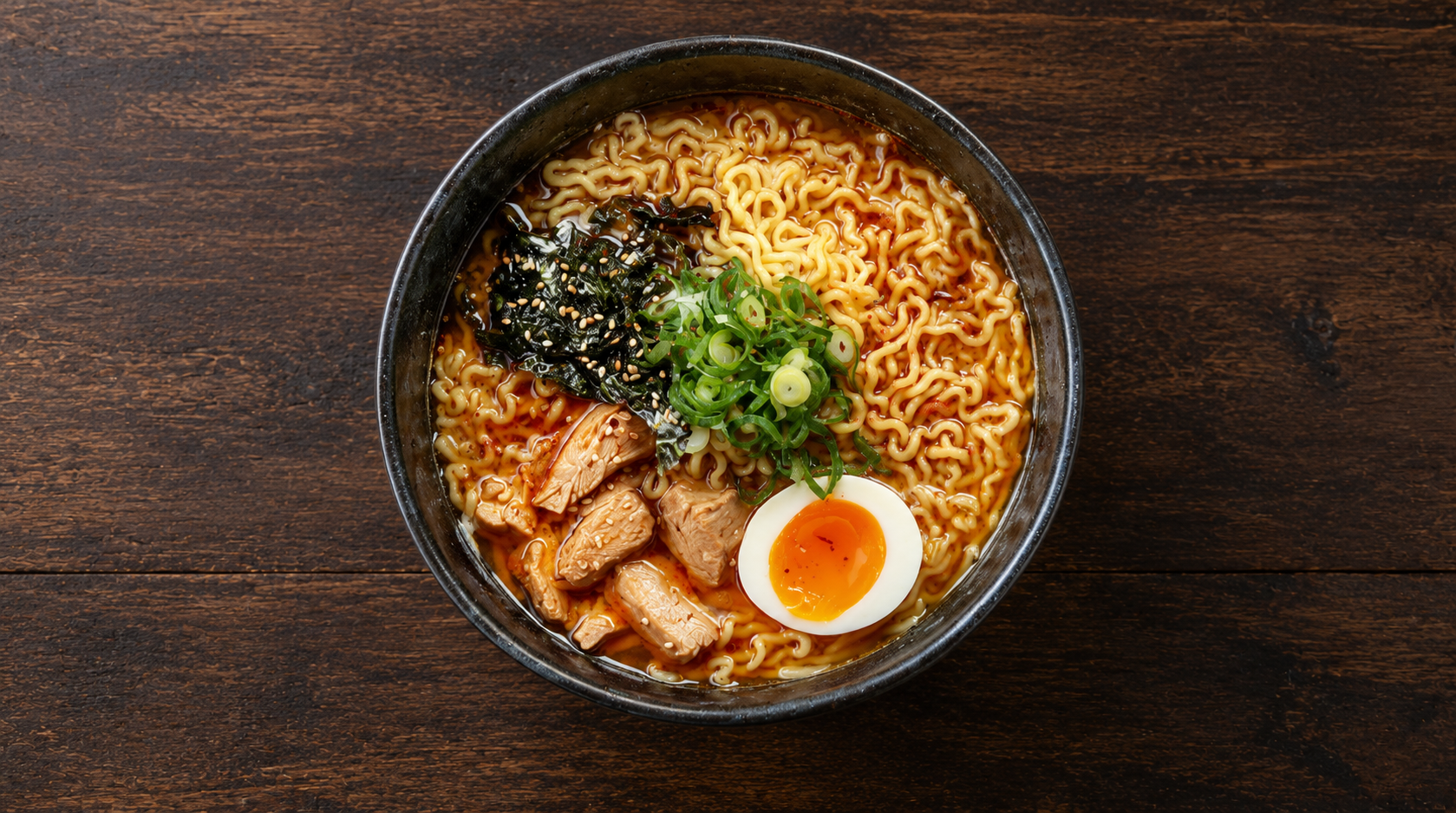
15-Minute High-Protein Chicken Ramen
Ingredients
Method
- Bring a small pot of water to a boil, add the cold eggs and cook for 6½ minutes (8–9 minutes for firm yolks). Transfer to ice water, then peel and halve.
- Meanwhile, bring the bone broth, water, garlic, ginger and soy sauce to a simmer in a medium pot.
- Add the sliced chicken and simmer gently for 4–5 minutes, until cooked through. Add the bok choy for the last 2 minutes.
- Add the noodles and cook for 2–3 minutes, or 30 seconds less than the package says. Stir in the sesame oil and, if you like, a little of the seasoning packet.
- Divide between 2 bowls and top with the eggs, green onions, nori, sesame seeds and kimchi or chili crisp.
Notes
Variations
| Version | What to change | Protein per bowl |
|---|---|---|
| Rotisserie chicken | Use 1½ cups shredded rotisserie chicken; add it at the end just to warm through. | About 53 g |
| Shrimp | Use 8 oz peeled shrimp and cook for 2–3 minutes in the broth. | About 50 g |
| Tofu | Use 7 oz extra-firm tofu, cubed, and vegetable broth. | About 28 g |
| Spicy miso | Whisk 1 tbsp white miso and 1 tsp chili crisp into the broth. | About 57 g |
| Kimchi | Top each bowl with ¼ cup kimchi just before serving. | About 55 g |
Common mistakes
- Using the whole seasoning packet. It’s the main source of sodium. Use a quarter or skip it.
- Overcooking the noodles. They keep softening in the hot broth, so cook them 30 seconds less than the package says.
- Boiling the chicken hard. Keep the broth at a gentle simmer so thin slices stay tender.
- Adding kimchi to boiling broth. Add it at the end to keep its crunch and live bacteria.
Storage
- Fridge: store the broth with chicken separately from the noodles, for up to 3 days.
- Eggs: peeled soft-boiled eggs keep in the fridge for up to 2 days in a covered container.
- Reheating: bring the broth to a simmer, then add freshly cooked noodles. Ramen noodles left in broth get soggy.
Frequently asked questions
How much protein is in this ramen?
About 55 g per bowl, mostly from the chicken, bone broth and egg. A plain instant ramen pack has around 5–9 g.
How can I make instant ramen less salty?
Use only a quarter of the seasoning packet or none at all, and flavor the broth with garlic, ginger, low-sodium soy sauce and a little sesame oil.
Can I use fresh ramen noodles instead?
Yes. Fresh or dried ramen noodles from the Asian section of the supermarket work perfectly and are usually not fried.
Is instant ramen bad for you?
On its own, it’s low in protein and high in sodium. As a base for a bowl with lean protein, eggs and vegetables, it can be part of a balanced meal.
Sources
- H-E-B. Mama Instant Ramen Noodle Soup Packs, Pork: nutrition facts. heb.com
- Yale Medicine. Sodium is everywhere. Here’s how to lower your intake. yalemedicine.org
- USDA Agricultural Research Service. FoodData Central. fdc.nal.usda.gov
- Flood JE, Rolls BJ. Soup preloads in a variety of forms reduce meal energy intake. Appetite. 2007;49(3):626–634. PubMed
- Westerterp-Plantenga MS, Nieuwenhuizen A, Tomé D, Soenen S, Westerterp KR. Dietary protein, weight loss, and weight maintenance. Annu Rev Nutr. 2009;29:21–41. Annual Reviews
- Wastyk HC, Fragiadakis GK, Perelman D, et al. Gut-microbiota-targeted diets modulate human immune status. Cell. 2021;184(16):4137–4153. Stanford Medicine
- Norton MI, Mochon D, Ariely D. The IKEA effect: when labor leads to love. J Consum Psychol. 2012;22(3):453–460. Harvard DASH
- Nissin Foods Group. Founder Momofuku Ando. nissin.com
- UConn Food Safety. Eggs and Egg Products. foodsafety.uconn.edu
This article is for general information and is not medical advice. Nutrition values are estimates and vary with the brands of noodles and broth you use.