
Beef rendang is one of the most flavorful dishes I know: tender beef slowly cooked in coconut milk with lemongrass, ginger, garlic, chili and warm spices until the sauce turns thick, dark and almost caramelized. Traditionally it simmers on the stove for hours and needs constant stirring. This slow cooker version does the long, slow part for you, and a few smart swaps make it lighter and higher in protein than the classic.
Each serving has about 31 grams of protein for around 275 calories before rice. Below you’ll find the story behind rendang, why tough cuts of beef turn so tender in a slow cooker, a fun fact about turmeric and black pepper, and tips to make meal planning easier.
| Protein | Calories | Time | Protein Score |
|---|---|---|---|
| 31 g per serving | About 275 kcal (without rice) | 20 min prep + 7–8 h | A (11.3 g per 100 kcal) |
What is beef rendang?
Rendang comes from the Minangkabau people of West Sumatra, Indonesia, and it’s also loved in Malaysia and Singapore. It was traditionally cooked for special occasions and could be kept for days, because the long cooking reduces the sauce until it’s rich and concentrated. In 2011, it famously topped a CNN Travel readers’ poll of the world’s most delicious foods.
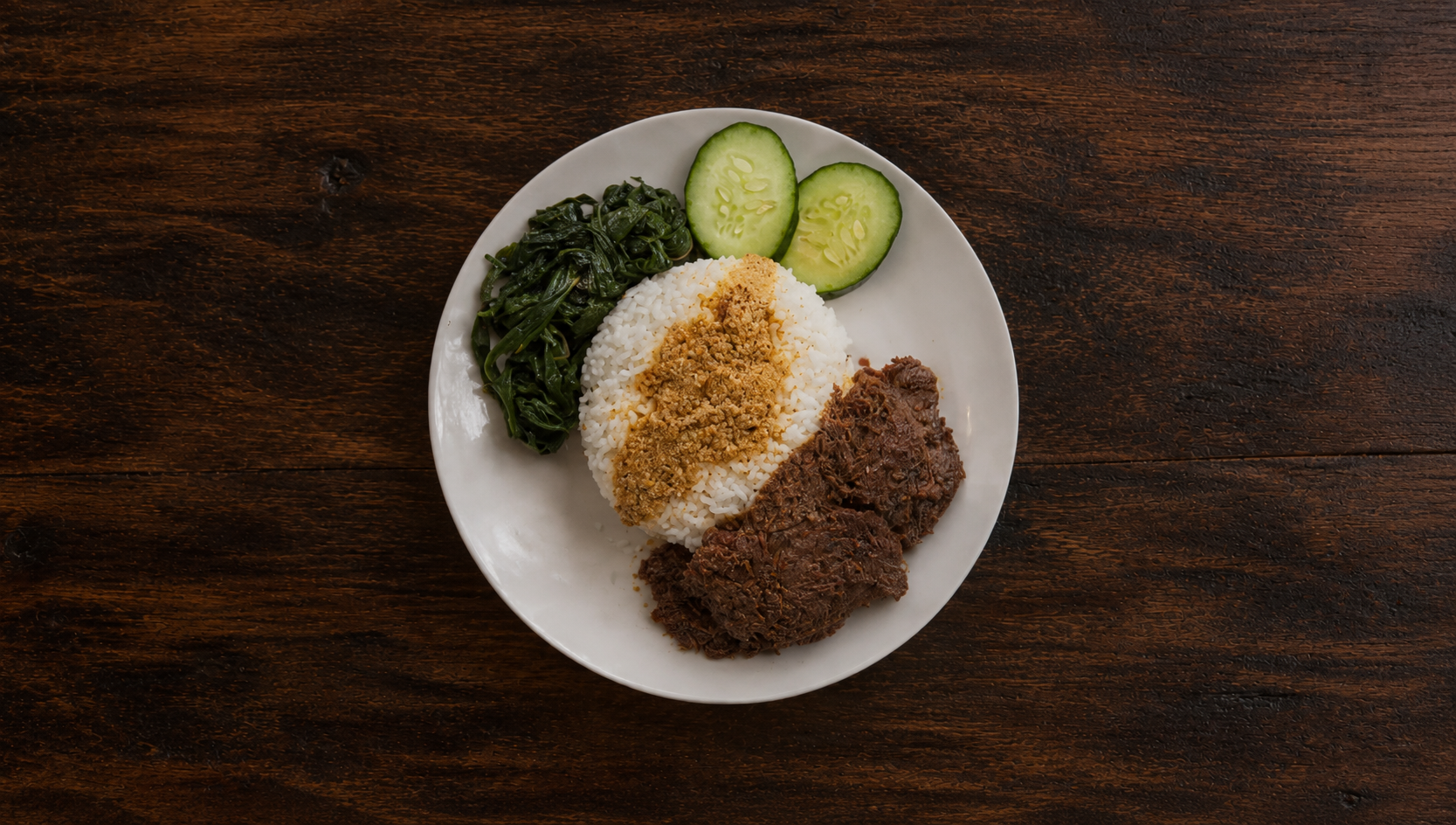
There are wetter and drier styles. The dry, dark version is cooked until almost all the liquid is gone. The version in this recipe is somewhere in between: deeply flavored, with enough sauce to spoon over rice, like in the photo.
How I made it lighter and higher in protein
- Light coconut milk instead of full-fat. It keeps the creamy coconut flavor with much less saturated fat. A little toasted coconut at the end brings back the richness.
- Lean beef chuck, well trimmed. Chuck stays tender after long cooking but has visible fat you can trim off before it goes in.
- More beef, less sauce. The recipe uses 2 lb of beef for 6 servings, so every portion is protein-heavy.
- Less sugar. One tablespoon of brown sugar is enough to balance the spices and tamarind.
Beef is one of the richest sources of protein, with about 20 g per 100 g of lean raw chuck [1]. It also provides heme iron, the type of iron found in meat, which your body absorbs more easily than the non-heme iron in plant foods [2]. That’s useful to know if you’re active or menstruating, since iron needs are higher. And as with any high-protein meal, it tends to keep you fuller than a low-protein one [3].
Why tough beef turns so tender in a slow cooker
Cuts like chuck come from muscles that work hard, so they contain a lot of connective tissue, mostly collagen. Cook them quickly and they’re chewy. Cook them low and slow in liquid for several hours, and the collagen gradually breaks down into gelatin. That’s what gives slow-cooked beef its soft, fall-apart texture and a sauce with a silky body.
This is also why lean steaks like sirloin are a bad choice for the slow cooker: they have little collagen, so long cooking only dries them out. For rendang, chuck, brisket or beef shank are the best options.
The spice paste: where the flavor comes from
| Ingredient | What it adds |
|---|---|
| Shallots or onion, garlic and ginger | The aromatic base |
| Lemongrass | A fresh, citrusy note that makes rendang taste like rendang |
| Dried red chilies or sambal oelek | Heat; use less for a milder version |
| Turmeric, coriander and cumin | Warm, earthy color and flavor |
| Cinnamon stick and star anise | A gentle sweetness and depth |
| Tamarind paste | A light sourness that balances the coconut |
| Toasted unsweetened coconut | The traditional finishing touch (called kerisik): nutty and rich |
A curious fact about turmeric: curcumin, the bright yellow compound in turmeric, is poorly absorbed on its own. In a well-known study using curcumin supplements, adding piperine, the compound that makes black pepper spicy, increased curcumin absorption about 20-fold [4]. The amounts in food are much smaller, so think of it as a fun reason to add a pinch of black pepper rather than a health promise.
Slow cooker beef rendang recipe
This makes 6 servings. Nutrition in the recipe card is for the beef and sauce only; add rice separately.
Slow Cooker Beef Rendang
Ingredients
Method
- Blend all the spice paste ingredients with 2–3 tbsp of the coconut milk until smooth.
- Heat the oil in a large skillet over medium-high heat and brown the beef in batches, 2–3 minutes per side. Transfer to the slow cooker.
- Lower the heat to medium, add the spice paste to the same skillet and fry for 3–4 minutes, stirring, until fragrant and darker. Scrape it into the slow cooker.
- Add the remaining coconut milk, cinnamon stick, star anise, tamarind, brown sugar and salt. Stir well.
- Cover and cook on low for 7–8 hours, or on high for 4–5 hours, until the beef is very tender.
- Stir in the toasted coconut. For a thicker, darker sauce, cook uncovered on high for the last 30–45 minutes. Remove the cinnamon and star anise and serve with rice and greens.
Notes
What to serve with it
| Side | Amount per serving | Adds about |
|---|---|---|
| Jasmine rice | ½ cup cooked | 100 kcal, 2 g protein |
| Cauliflower rice | 1 cup cooked | 25 kcal, 2 g protein |
| Sautéed spinach or water spinach with garlic | 1 cup | 40 kcal, 3 g protein |
| Cucumber slices | ½ cucumber | 10 kcal |
The cool, crunchy cucumber is a classic partner for rich rendang, and a side of garlicky greens adds volume and color, just like on the plate in the photo.
Slow cooker food safety tips
- Thaw the beef first. Frozen meat stays too long in the temperature range where bacteria grow. Always thaw it in the fridge before it goes in the slow cooker [5].
- Keep the lid on. Every time you lift it, the slow cooker loses heat and needs time to recover [5].
- Fill it to the right level. Between half and two-thirds full is ideal for even cooking.
- Cool leftovers quickly. Refrigerate them within 2 hours and eat them within 3–4 days [6].
Psychology tip: plan once, eat well all week
Slow cooker recipes are perfect for meal planning, and planning itself seems to make a difference. In a study with more than 40,000 French adults, people who planned their meals ahead had more food variety and better overall diet quality, and they were less likely to have obesity [7]. The study shows an association, not cause and effect, but it fits what many of us experience: when dinner is already decided, it’s easier to avoid last-minute takeout.
- Pick one “cook once” day and make a big batch of something like this rendang.
- Portion it right away into containers, so the decision about how much to eat is already made.
- Rotate 3–4 recipes so you don’t get bored. My high-protein meal prep plan and my garlic sesame chicken and green beans are easy ones to add.
Storage and freezing
- Fridge: up to 3–4 days in an airtight container [6]. Like many stews, rendang tastes even better the next day.
- Freezer: freeze in portions for up to 3 months. Thaw overnight in the fridge.
- Reheat: warm in a pan or microwave with a splash of water until steaming hot (165°F / 74°C) [6].
Common mistakes to avoid
- Skipping the browning. Searing the beef and frying the spice paste for a few minutes before slow cooking adds a lot of flavor. If you’re short on time, at least fry the paste.
- Using a lean steak cut. It will dry out. Use chuck, brisket or shank.
- Adding too much liquid. Slow cookers don’t evaporate much. One can of coconut milk is enough.
- Not reducing the sauce. For a thicker, darker rendang, cook it uncovered on high for the last 30–45 minutes.
Frequently asked questions
Can I make beef rendang in an Instant Pot?
Yes. Use the sauté function to brown the beef and paste, then pressure cook on high for 40–45 minutes with a natural release. Reduce the sauce on sauté mode at the end.
Is beef rendang spicy?
It has a warm heat, but you control it. Use 2 dried chilies for mild, 4–5 for medium, or add sambal oelek to taste.
Can I use chicken instead of beef?
Yes. Use boneless chicken thighs and cook on low for 4–5 hours. Chicken rendang is popular in Malaysia and Indonesia too.
What if I can’t find lemongrass?
Look for lemongrass paste in the produce section, or use the zest of 1 lime. The flavor won’t be the same, but it will still be delicious.
How much protein is in beef rendang?
This lighter version has about 31 g of protein per serving, without rice.
Sources
- USDA Agricultural Research Service. FoodData Central. fdc.nal.usda.gov
- National Institutes of Health, Office of Dietary Supplements. Iron: Fact Sheet for Health Professionals. ods.od.nih.gov
- Westerterp-Plantenga MS, Nieuwenhuizen A, Tomé D, Soenen S, Westerterp KR. Dietary protein, weight loss, and weight maintenance. Annu Rev Nutr. 2009;29:21–41. Annual Reviews
- Shoba G, Joy D, Joseph T, et al. Influence of piperine on the pharmacokinetics of curcumin in animals and human volunteers. Planta Med. 1998;64(4):353–356. PubMed
- Clemson Cooperative Extension, Home & Garden Information Center. Slow Cooker Food Safety. hgic.clemson.edu
- USDA Food Safety and Inspection Service. Leftovers and Food Safety. fsis.usda.gov
- Ducrot P, Méjean C, Aroumougame V, et al. Meal planning is associated with food variety, diet quality and body weight status in a large sample of French adults. Int J Behav Nutr Phys Act. 2017;14:12. PubMed
This article is for general information and is not medical advice. Nutrition values are estimates and vary with the cut of beef and brands you use.