
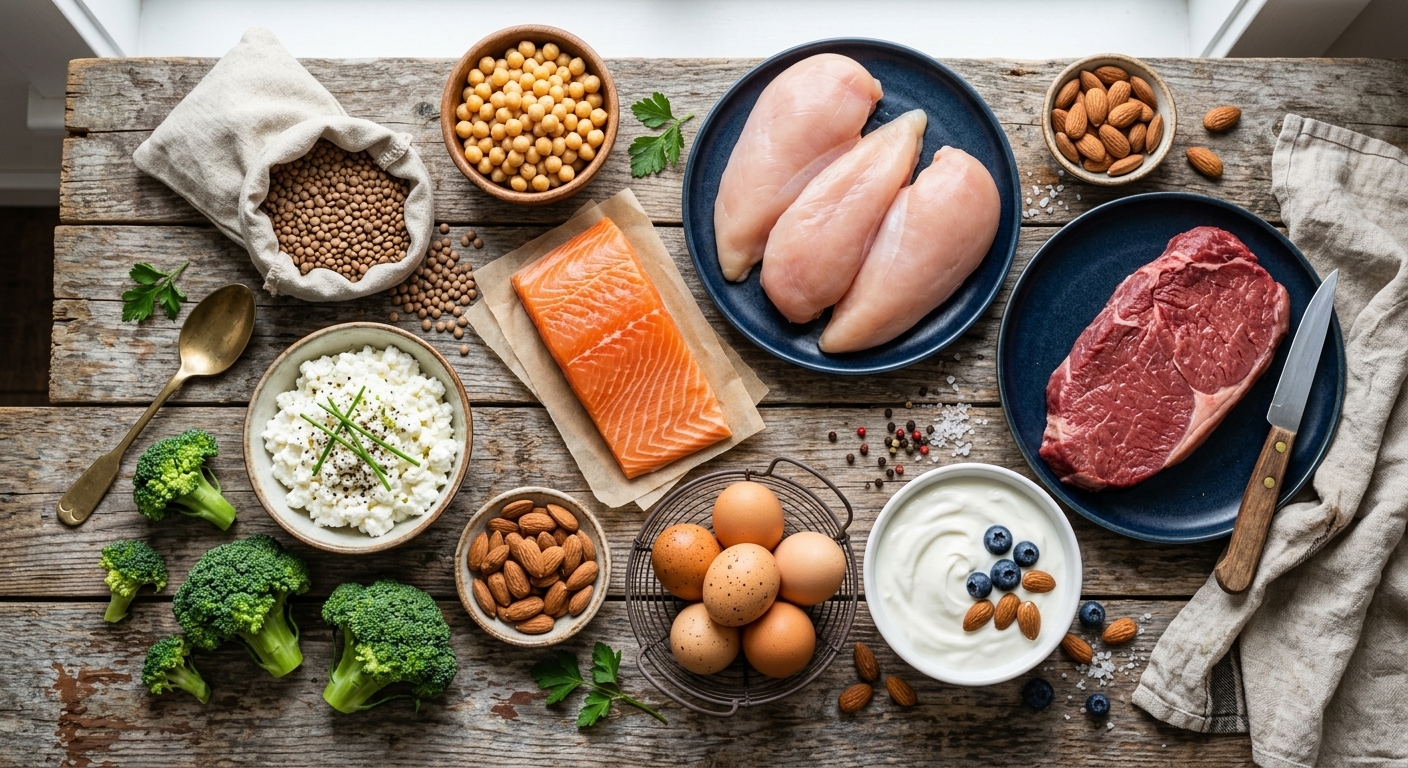
“How much protein do I actually need?” is one of the most common nutrition questions, and the answers online range from “you’re eating too much already” to “at least 1 gram per pound.” The truth is somewhere in between, and it depends on your body weight, how active you are, your age and your goals.
In this guide I’ll walk you through what the research says, give you a simple table to find your number in seconds, show you which foods give you the most protein for the calories, and bust a few common myths along the way.
| Who | Protein per day | Per pound of body weight |
|---|---|---|
| Minimum for most adults (RDA) | 0.8 g per kg | About 0.36 g |
| Active adults and people losing weight | 1.2–1.6 g per kg | About 0.55–0.75 g |
| Strength training to build muscle | 1.4–2.0 g per kg | About 0.65–0.9 g |
| Adults over 65 | 1.0–1.2 g per kg | About 0.45–0.55 g |
Why protein is so important
Protein isn’t just for bodybuilders. Every cell in your body contains protein, and you need it to repair cells and make new ones [11]. It’s one of the most important things on your plate, at every age.
- Muscles: protein is the building material for muscle, which keeps you strong, mobile and burning energy.
- Bones, skin and hair: collagen and keratin, the proteins that give them structure, are made from the amino acids you eat.
- Enzymes and hormones: many of the molecules that digest your food and send signals around your body are proteins.
- Immune system: the antibodies that fight infections are proteins too.
- Fullness: protein is the most filling macronutrient, which helps you eat well without feeling hungry all day [4].
Proteins are made of 20 amino acids. Nine of them are “essential,” which means your body can’t make them and they have to come from food. And unlike fat, your body doesn’t keep a reserve of amino acids for later, so you need a steady supply every day [12].
Did you know? After age 30, adults lose roughly 3–8% of their muscle mass per decade, and the loss speeds up after 60 [13]. Eating enough protein, together with strength training, is one of the best ways to slow it down.
The official minimum: 0.8 g per kilogram
The Recommended Dietary Allowance (RDA) for protein is 0.8 g per kilogram of body weight per day for healthy adults [1]. For a 150-lb (68 kg) person, that’s about 54 g a day.
Here’s the important part: the RDA is the amount needed to prevent deficiency in nearly all healthy people. It’s a minimum, not an optimal target. The same report sets a wide acceptable range for protein of 10–35% of your daily calories [1], which leaves plenty of room to eat more.
If you work out: 1.4–2.0 g per kilogram
If you lift weights or train regularly, you need more. The International Society of Sports Nutrition recommends 1.4–2.0 g of protein per kilogram per day for most exercising people [2].
A large meta-analysis of resistance training studies found that extra protein helped people gain more muscle and strength, with the benefits leveling off at around 1.6 g per kilogram per day on average [3]. Some people may benefit from going up to about 2.2 g per kilogram, but for most, 1.6 g is a practical, science-backed target.
If you’re trying to lose weight: aim higher, not lower
When you eat fewer calories, your body can lose muscle along with fat. Eating more protein helps protect that muscle, and higher-protein diets also tend to increase fullness, which makes a calorie deficit easier to stick to [4]. That’s why many experts suggest about 1.2–1.6 g per kilogram during weight loss, especially if you combine it with strength training.
Protein also has the highest thermic effect of the three macronutrients: your body uses roughly 20–30% of its calories just to digest and process it, compared with about 5–10% for carbohydrates and 0–3% for fat [5]. It won’t melt fat on its own, but every little bit helps.
Over 65: protein matters even more
As we age, muscles respond less to protein, a phenomenon researchers call “anabolic resistance.” An international expert group (PROT-AGE) recommends that healthy adults over 65 eat at least 1.0–1.2 g of protein per kilogram per day, and more if they’re active or recovering from illness [6]. Getting enough protein, along with strength exercise, helps protect muscle, strength and independence later in life.
Find your number: quick protein table
Find your weight in the left column and pick the column that matches your lifestyle. Values are grams of protein per day, rounded.
| Body weight | Minimum (0.8 g/kg) | Active or losing weight (1.2 g/kg) | Building muscle (1.6 g/kg) |
|---|---|---|---|
| 120 lb (54 kg) | 44 g | 65 g | 87 g |
| 140 lb (64 kg) | 51 g | 76 g | 102 g |
| 160 lb (73 kg) | 58 g | 87 g | 116 g |
| 180 lb (82 kg) | 65 g | 98 g | 131 g |
| 200 lb (91 kg) | 73 g | 109 g | 145 g |
Tip: if you have a lot of weight to lose, using your goal weight instead of your current weight gives a more realistic target.
How to spread protein through the day
Your total daily protein matters most, but how you split it can help too. A review in the Journal of the International Society of Sports Nutrition suggests aiming for about 0.4 g per kilogram per meal, across at least four meals, to make the most of each one for muscle building [7]. For a 150-lb person, that’s about 25–30 g per meal.
Most people eat very little protein at breakfast and most of it at dinner. Moving some of that protein to the morning is one of the easiest changes you can make. Here’s what a day of about 135 g of protein can look like using recipes from this site:
| Meal | Recipe | Protein |
|---|---|---|
| Breakfast | High-protein overnight oats | 36 g |
| Lunch | Garlic sesame chicken and green beans | 43 g |
| Snack | Iced protein coffee | 25 g |
| Dinner | Slow cooker beef rendang | 31 g |
| Total | About 135 g |
The best protein foods for the calories
Not all protein foods are equal. Some give you a lot of protein for very few calories; others come with a lot of fat or carbs. This table shows common foods with approximate values from USDA data [8]. The last column, protein per 100 calories, is the same idea behind the Protein Score you see in our recipes.
| Food | Serving | Protein | Calories | Protein per 100 kcal |
|---|---|---|---|---|
| Chicken breast, cooked | 3 oz | 26 g | 140 | 18.6 g |
| Canned tuna in water | 3 oz | 20 g | 100 | 20 g |
| Plain nonfat Greek yogurt | 1 cup | 23 g | 130 | 17.7 g |
| Whey protein powder | 1 scoop (30 g) | 24 g | 120 | 20 g |
| Cottage cheese, 2% | 1 cup | 24 g | 185 | 13 g |
| Salmon, cooked | 3 oz | 22 g | 175 | 12.6 g |
| Lean ground beef (90%), cooked | 3 oz | 22 g | 185 | 11.9 g |
| Extra-firm tofu | 7 oz (½ block) | 20 g | 200 | 10 g |
| Edamame, shelled | 1 cup | 18 g | 190 | 9.5 g |
| Eggs | 2 large | 12 g | 145 | 8.3 g |
| Lentils, cooked | 1 cup | 18 g | 230 | 7.8 g |
| Milk, 2% | 1 cup | 8 g | 120 | 6.7 g |
Plant proteins like lentils and beans have less protein per calorie, but they bring fiber and other nutrients. A mix of animal and plant sources is a great approach. If you eat mostly plants, our crispy tofu with broccoli and rice is an easy place to start.
3 protein myths, busted
Myth 1: “Your body can only use 30 g of protein per meal”
You’ve probably heard this one at the gym. Your body absorbs basically all the protein you eat; the question is how much goes to building muscle. A 2023 study found that after exercise, a 100 g protein meal produced a larger and longer-lasting muscle-building response than a 25 g meal [9]. Spreading protein across meals is still a smart habit, but a bigger protein meal isn’t “wasted.”
Myth 2: “High-protein diets damage your kidneys”
In healthy adults, research doesn’t support this. A systematic review and meta-analysis found no meaningful difference in kidney function between healthy people eating higher-protein diets and those eating lower or normal amounts [10]. However, if you already have kidney disease, your needs are different, so talk to your doctor before increasing protein.
Myth 3: “You need protein shakes to hit your goal”
Shakes are convenient, but not necessary. Whole foods like chicken, fish, eggs, Greek yogurt, cottage cheese, tofu and legumes can easily cover your needs. Use powder as a tool when it’s helpful, like in oats or coffee, not as a requirement.
Simple ways to eat more protein
- Build every meal around a protein source. Decide on the protein first, then add vegetables and carbs.
- Upgrade your breakfast. Swap a bagel or cereal for eggs, Greek yogurt, cottage cheese or protein pancakes.
- Choose high-protein snacks. Greek yogurt, cottage cheese, edamame, jerky or a protein coffee keep you full between meals.
- Cook once, eat twice. Make extra chicken, beef or tofu for tomorrow’s lunch. My high-protein meal prep plan shows how.
- Use dairy in sauces and dips. Greek yogurt can replace sour cream, mayo or cream in many recipes.
Frequently asked questions
How much protein do I need a day to lose weight?
Most research supports about 1.2–1.6 g per kilogram of body weight per day during weight loss, ideally combined with strength training to protect muscle.
Is 100 g of protein a day too much?
For most active adults, no. For a 160-lb (73 kg) person, 100 g is about 1.4 g per kilogram, which is well within the recommended range for active people.
Do women need less protein than men?
Protein needs are based mainly on body weight and activity, not gender. Women usually need less in total simply because they weigh less on average. Needs go up during pregnancy and breastfeeding.
Can you eat too much protein?
Healthy adults tolerate a wide range of protein intake. Very high intakes can crowd out other foods like fruits, vegetables and whole grains, so balance still matters.
What counts as a high-protein meal?
A meal with at least 25–30 g of protein is a good benchmark for most adults. All the recipes on this site are designed to reach that.
Sources
- Institute of Medicine. Dietary Reference Intakes for Energy, Carbohydrate, Fiber, Fat, Fatty Acids, Cholesterol, Protein, and Amino Acids. Washington, DC: National Academies Press; 2005. nap.nationalacademies.org
- Jäger R, Kerksick CM, Campbell BI, et al. International Society of Sports Nutrition Position Stand: protein and exercise. J Int Soc Sports Nutr. 2017;14:20. PubMed
- Morton RW, Murphy KT, McKellar SR, et al. A systematic review, meta-analysis and meta-regression of the effect of protein supplementation on resistance training-induced gains in muscle mass and strength in healthy adults. Br J Sports Med. 2018;52(6):376–384. PubMed
- Leidy HJ, Clifton PM, Astrup A, et al. The role of protein in weight loss and maintenance. Am J Clin Nutr. 2015;101(6):1320S–1329S. PubMed
- Westerterp KR. Diet induced thermogenesis. Nutr Metab (Lond). 2004;1(1):5. PubMed
- Bauer J, Biolo G, Cederholm T, et al. Evidence-based recommendations for optimal dietary protein intake in older people: a position paper from the PROT-AGE Study Group. J Am Med Dir Assoc. 2013;14(8):542–559. UTMB
- Schoenfeld BJ, Aragon AA. How much protein can the body use in a single meal for muscle-building? Implications for daily protein distribution. J Int Soc Sports Nutr. 2018;15:10. PubMed
- USDA Agricultural Research Service. FoodData Central. fdc.nal.usda.gov
- Trommelen J, van Lieshout GAA, Nyakayiru J, et al. The anabolic response to protein ingestion during recovery from exercise has no upper limit in magnitude and duration in vivo in humans. Cell Rep Med. 2023;4(12):101324. PMC
- Devries MC, Sithamparapillai A, Brimble KS, et al. Changes in kidney function do not differ between healthy adults consuming higher- compared with lower- or normal-protein diets: a systematic review and meta-analysis. J Nutr. 2018;148(11):1760–1775. DOI
- MedlinePlus, U.S. National Library of Medicine. Protein in diet. medlineplus.gov
- MedlinePlus, U.S. National Library of Medicine. Amino acids. medlineplus.gov
- Volpi E, Nazemi R, Fujita S. Muscle tissue changes with aging. Curr Opin Clin Nutr Metab Care. 2004;7(4):405–410. UTMB
This article is for general information and is not medical advice. If you have a medical condition, are pregnant or have kidney disease, talk to your doctor or a registered dietitian about your protein needs.