
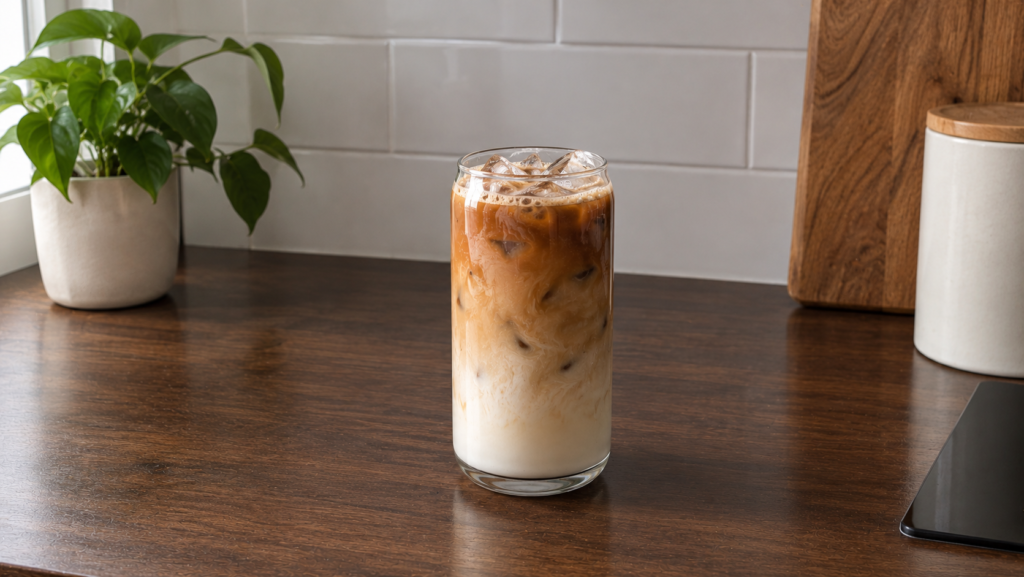
Let’s be honest: most of us don’t get enough protein in our day. This iced protein coffee is an easy fix for the afternoon: basically an iced latte, cold coffee with ice and oat milk, with one scoop of protein powder in your favorite flavor. It adds about 25 g of protein almost without noticing.
It takes 3 minutes, and there’s one step that makes all the difference between a smooth drink and a glass full of lumps.
| Protein | Calories | Time | Caffeine |
|---|---|---|---|
| 25 g | About 180 kcal | 3 min | Decaf (2–15 mg) |
Why decaf works best in the afternoon
If you drink it in the afternoon, make it with decaf. A good night’s sleep is worth more than an extra coffee, and the research backs that up.
There is research behind that habit. In a study published in the Journal of Clinical Sleep Medicine, 400 mg of caffeine taken 6 hours before bedtime still cut total sleep time by more than an hour, even though the participants didn’t notice it [3]. Decaf isn’t completely caffeine-free, but an 8-oz cup usually has only 2–15 mg, compared with the 400 mg a day the FDA cites as an amount most adults tolerate [4].
Why add protein to your snack
Protein is the most filling macronutrient. Reviews of controlled studies show that higher-protein meals increase feelings of fullness, and that higher-protein diets help preserve lean muscle during weight loss [1]. If you also train, a meta-analysis of 49 trials found that extra protein boosts the muscle you gain from strength training [2]. A snack with 25 g is an easy way to move closer to your daily goal.
How to make iced protein coffee
- A nice glass. A tall can-shaped glass of about 16 oz (470 ml) lets you see the layers.
- Two fingers of water and the scoop of protein. Before anything else, dissolve the protein in a little water.
- Dissolve it really well. This is the most important step. Stir or use a small milk frother until there are no lumps at all. If you add the powder straight to cold oat milk or hot coffee, it clumps.
- Add the ice, almost to the top.
- A splash of oat milk.
- Pour the coffee into the gap that’s left. Not to brag, but once you get the measurements right, the layers come out perfect every time.
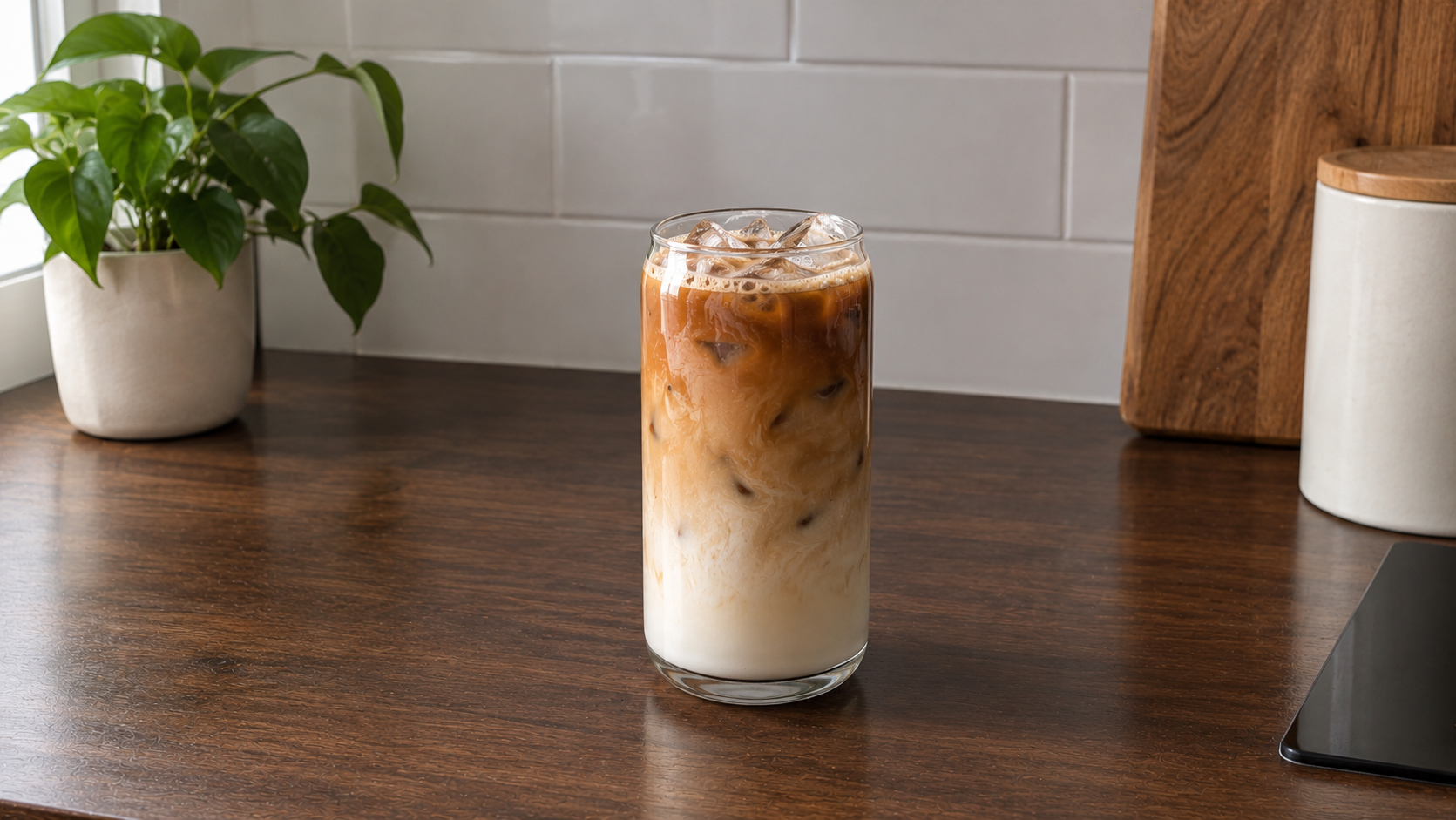
Iced Protein Coffee with Oat Milk
Ingredients
Method
- Pour the water into a tall glass (about 16 oz / 470 ml) and add the scoop of protein powder.
- Stir or whisk until the protein is completely dissolved and there are no lumps. A handheld milk frother does it in about 10 seconds. This is the most important step.
- Fill the glass with ice.
- Pour in the oat milk.
- Pour the decaf espresso into the space left at the top. Enjoy the layers, then stir before drinking.
Notes
Tips and swaps
- Flavor: vanilla, caramel, salted caramel or cookies-and-cream protein all work. Chocolate turns it into an iced mocha.
- More protein: swap the oat milk for soy milk or ultra-filtered dairy milk for a few extra grams.
- Sweeter: most flavored protein powders are already sweet. If you want more, add a teaspoon of sugar-free syrup.
- Regular coffee: use normal espresso if you drink it in the morning and caffeine doesn’t affect your sleep.
Other ways to make it
Hot: whisk the protein into warm milk first, then add the hot coffee. Blended: blend cold coffee, milk, one scoop of protein and a cup of ice for a frappé-style drink. The recipe card is for the iced version, so treat these as ideas to try.
Which milk gives you the most protein?
The milk you choose can change your coffee more than you think. Here’s how common options compare per 1 cup (240 ml), using approximate values from USDA data [5]. Check your own label, since brands vary.
| Milk (1 cup) | Protein | Calories | Good to know |
|---|---|---|---|
| Ultra-filtered (“high-protein”) milk | 13–14 g | About 120 | Filtered to concentrate protein and reduce sugar |
| Skim milk | 8 g | About 85 | Most protein for the fewest calories |
| 2% milk | 8 g | About 120 | Creamy, classic latte taste |
| Unsweetened soy milk | 7 g | About 80 | The plant milk closest to dairy in protein |
| Oat milk | 2–3 g | About 120 | Creamy and froths well, but low in protein |
| Unsweetened almond milk | 1 g | About 40 | Very light, almost no protein |
Oat milk gives it a creamy taste, and the protein comes from the scoop. If you prefer almond milk, that’s fine: the powder is doing the heavy lifting.
No protein powder? Make it with protein milk
Protein powder is optional. Coffee made with a high-protein milk still adds a good amount of protein:
- Fill a glass with ice and add ½ cup (120 ml) of cold coffee or cold brew.
- Top with 1 cup (240 ml) of ultra-filtered milk and stir.
- Result: about 13–14 g of protein and roughly 130 calories. Use 1½ cups of milk in a bigger glass and you’ll get close to 20 g.
It’s less protein than the powder version, but it’s the easiest switch you can make, and there are no lumps to worry about.
Why protein powder clumps in coffee
Whey proteins are sensitive to heat. When they hit hot coffee, they start to unfold and stick to each other, which is why you get those little lumps floating on top. Dissolving the powder in a little cold water first lets each particle hydrate before it meets the coffee. With iced coffee the risk is lower, but the cold-water step still gives you the smoothest drink.
Hot coffee or cold brew: is cold brew really less acidic?
Many people say cold brew is gentler on the stomach. A study in Scientific Reports compared hot and cold brew made from the same beans and found that their pH was very similar. Hot coffee had higher titratable acidity, which may explain why cold brew tastes smoother. Hot coffee also showed more antioxidant activity [6]. In short: choose the one you enjoy most. Both work in this recipe.
Why a daily ritual makes protein easier
Eating more protein isn’t about willpower, it’s about habits. In a well-known study from University College London, 96 volunteers repeated a healthy behavior every day, like drinking water with lunch. On average, it took 66 days for the behavior to feel automatic, with a huge range from 18 to 254 days. And missing a single day didn’t undo their progress [7].
That’s why linking this coffee to something you already do helps so much. Mine is always the same: the afternoon break, the same glass, the same few steps. After a while you stop deciding and just do it, and those 25 g of protein add up every single day.
Frequently asked questions
Can you put protein powder in coffee?
Yes. The trick is to dissolve it in a little water or warm milk first. Added straight to coffee, especially hot coffee, it tends to form lumps.
How much protein does this iced coffee have?
About 25 g per glass with one 30 g scoop of whey protein. The exact amount depends on your protein powder, so check its label.
Is decaf coffee caffeine-free?
Not completely. Decaf usually has 2–15 mg of caffeine per 8-oz cup, far less than regular coffee [4].
What is the best milk for protein coffee?
Oat milk is the creamiest option, but soy milk and dairy milk add more protein, so choose based on your taste and your goals.
Looking for more ideas? Try my high-protein meal prep for the week or browse more high-protein breakfast recipes.
Sources
- Leidy HJ, Clifton PM, Astrup A, et al. The role of protein in weight loss and maintenance. Am J Clin Nutr. 2015;101(6):1320S–1329S. PubMed
- Morton RW, Murphy KT, McKellar SR, et al. A systematic review, meta-analysis and meta-regression of the effect of protein supplementation on resistance training-induced gains in muscle mass and strength in healthy adults. Br J Sports Med. 2018;52(6):376–384. PubMed
- Drake C, Roehrs T, Shambroom J, Roth T. Caffeine effects on sleep taken 0, 3, or 6 hours before going to bed. J Clin Sleep Med. 2013;9(11):1195–1200. PMC
- U.S. Food and Drug Administration. Spilling the Beans: How Much Caffeine Is Too Much? fda.gov
- USDA Agricultural Research Service. FoodData Central. fdc.nal.usda.gov
- Rao NZ, Fuller M. Acidity and antioxidant activity of cold brew coffee. Sci Rep. 2018;8:16030. PMC
- Lally P, van Jaarsveld CHM, Potts HWW, Wardle J. How are habits formed: modelling habit formation in the real world. Eur J Soc Psychol. 2010;40(6):998–1009. UCL
This article is for general information and is not medical advice. Nutrition values are estimates and vary with the protein powder and milk you use.