
When the fridge is almost empty and payday is still a few days away, this lentil stew is what I make. A bag of dried lentils, a few vegetables, some broth and spices, and an hour later you have a big, cozy pot of food that tastes like it cost much more than it did.
This version is designed to be high in protein: each bowl has about 28 grams, thanks to lentils, bone broth and a little Parmesan on top. It’s also packed with fiber. Below you’ll find what it costs, why lentils keep you full for so long, what they do for your gut, and a surprising psychology trick to make healthy food taste better.
| Protein | Calories | Fiber | Time | Cost | Protein Score |
|---|---|---|---|---|---|
| 28 g per bowl | About 370 kcal | About 10 g | 15 min prep + 40 min | About $2 per bowl | B (7.6 g per 100 kcal) |
What this lentil stew really costs
Dried legumes are among the cheapest protein foods you can buy. The US average price for dried beans was about $1.67 per pound in September 2026, according to the Bureau of Labor Statistics [1], and lentils are usually in the same price range. Here’s an estimate for 6 bowls:
| Ingredient | Amount | Approx. cost |
|---|---|---|
| Dried green or brown lentils | 1 lb | About $1.70 |
| Chicken bone broth | 4 cups (32 oz) | About $4.00 |
| Canned diced tomatoes + tomato paste | 14.5 oz + 2 tbsp | About $1.50 |
| Onion, carrots, celery and garlic | 1 + 2 + 2 + 4 cloves | About $2.00 |
| Kale or spinach, lemon | 3 cups + 1 | About $1.50 |
| Parmesan, olive oil and spices | Small amounts | About $1.20 |
| Total | 6 bowls | About $11.90 (≈ $2 per bowl) |
Use regular broth instead of bone broth and the cost drops to about $1.60 per bowl, with around 23 g of protein. Prices vary by store and region.
Lentils: a protein and fiber powerhouse
One cup of cooked lentils has about 18 g of protein and around 15 g of fiber, for roughly 230 calories [2]. Few foods give you that much of both at once, and that combination is exactly what makes this stew so satisfying. The bone broth adds about 9 g of protein per cup compared with almost none in regular broth, which is how each bowl reaches 28 g.
Why lentils keep you full for hours
Lentils, beans, chickpeas and peas belong to a group called pulses, and they’re famous for being filling. A meta-analysis of nine clinical trials found that people felt 31% fuller after eating pulses compared with control meals [3].
There’s also a fascinating “second-meal effect.” In a study with young men, eating lentils or chickpeas for breakfast lowered blood sugar after that meal compared with white bread. It also reduced appetite after a pizza lunch eaten two hours later [4]. In other words, a lentil meal can keep helping you at the next one.
Lentils and your gut microbiota
With my training in microbiota and digestive health, this is my favorite part. Much of the fiber in lentils isn’t digested in the small intestine. It travels to the colon, where your gut bacteria ferment it and use it as food. A well-fed microbiota is one of the foundations of good digestive health.
Variety matters too. In the American Gut Project, one of the largest citizen-science microbiome studies, people who ate more than 30 different types of plants per week had more diverse gut bacteria than those who ate 10 or fewer [5]. Count the plants in this stew: lentils, onion, carrot, celery, garlic, tomato, kale, lemon, cumin, smoked paprika, turmeric and bay leaf. That’s 12 plants in a single pot.
Tip: if you’re not used to eating legumes, start with smaller portions and drink enough water. Your gut usually adapts within a few weeks.
Healthy food can taste amazing
Many of us carry a hidden belief that healthy food can’t be delicious. Researchers call it the “unhealthy = tasty” intuition. In one experiment, people who were told a drink was unhealthy rated it as tastier than people who were told the same drink was healthy [6].
That’s why I never present this stew as “diet food.” The cumin, smoked paprika, garlic and a squeeze of lemon at the end are what make it taste rich and comforting. When healthy food is seasoned well, the expectation of “bland” disappears, and you actually want to make it again.
High-protein lentil stew recipe
This makes 6 big bowls. It thickens as it cools, so add a splash of water or broth when reheating.
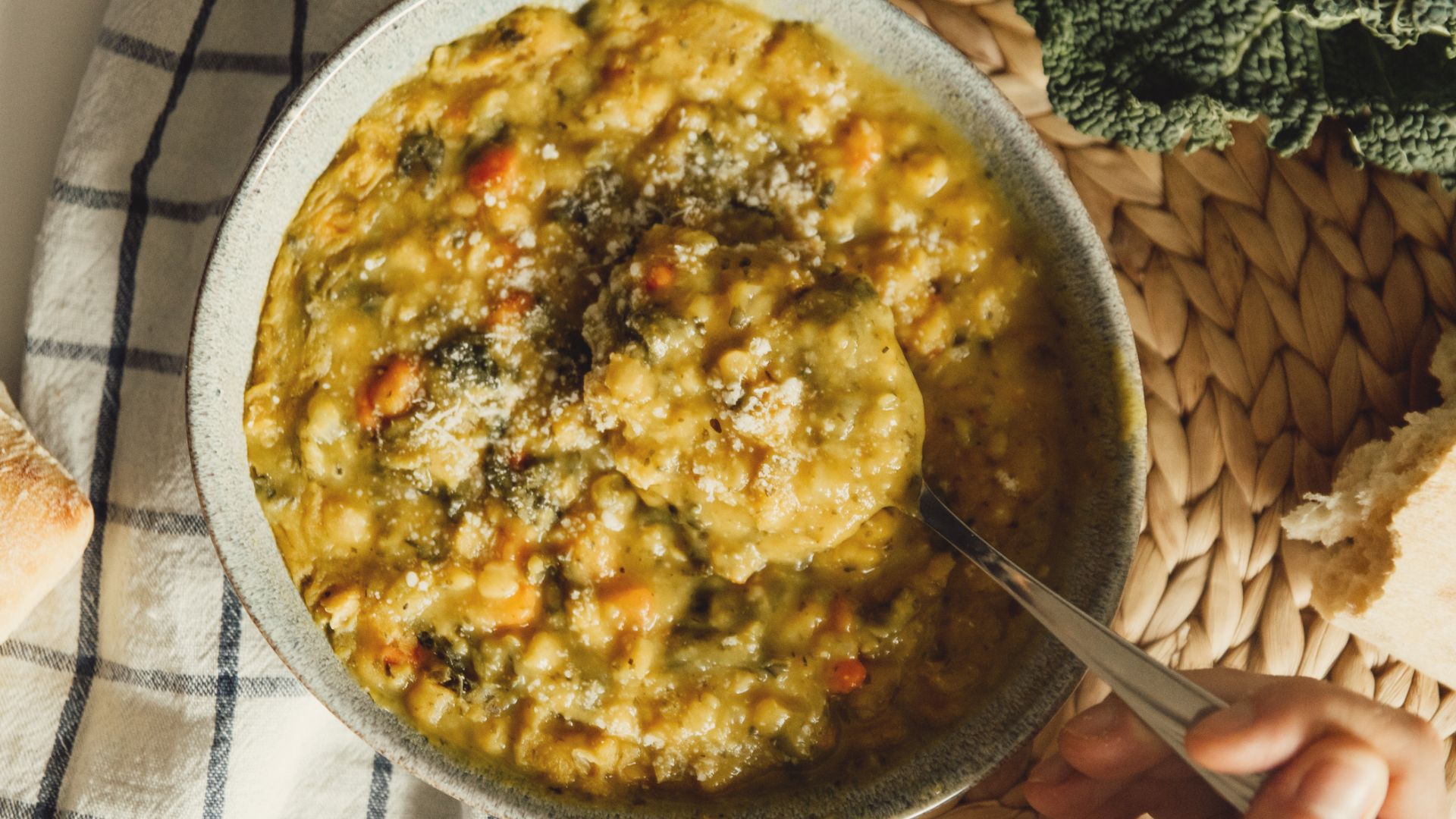
High-Protein Lentil Stew
Ingredients
Method
- Heat the olive oil in a large pot over medium heat. Add the onion, carrots and celery and cook for 6–8 minutes until softened.
- Add the garlic, cumin, smoked paprika, turmeric and tomato paste and cook for 1 minute, stirring, until fragrant.
- Add the lentils, diced tomatoes, broth, water and bay leaf. Bring to a boil, then lower the heat, cover partially and simmer for 30–35 minutes, until the lentils are tender.
- Stir in the kale or spinach and cook for 3–5 minutes until wilted. Remove the bay leaf.
- Add the lemon juice, season with salt and pepper, and serve each bowl topped with 1 tbsp of grated Parmesan.
Notes
Budget tips
- Buy dried lentils, not canned. They’re much cheaper per serving and don’t need soaking.
- Use any vegetables you have. Zucchini, bell pepper, potatoes or frozen spinach all work.
- Buy bone broth on sale and freeze it, or make your own from a leftover chicken carcass.
- Double the batch. Lentil stew freezes well, and a second pot costs only a few dollars more.
For another cheap, filling dinner, try my crispy tofu with broccoli and rice. And if you want to know how much protein you actually need, read my daily protein guide.
Variations
| Version | What to change | Protein per bowl |
|---|---|---|
| Vegan | Use vegetable broth and skip the Parmesan. Top with toasted seeds. | About 21 g |
| With sausage | Brown 8 oz sliced chicken sausage before the vegetables. | About 33 g |
| Red lentil | Use red lentils and cook 20–25 minutes for a creamier, soup-like texture. | About 28 g |
| Curry-style | Add 1 tbsp curry powder and finish with a spoonful of Greek yogurt. | About 29 g |
Meal prep and storage
- Fridge: keep it in airtight containers for 3–4 days [7].
- Freezer: freeze in portions for up to 3–4 months for best quality [7].
- Reheating: heat until steaming, adding a little water or broth because the lentils keep absorbing liquid.
Common mistakes
- Adding acid too early. Add the lemon juice at the end. Acid can keep lentils firm if added at the start.
- Overcooking green or brown lentils. Start checking at 30 minutes: they should be tender but hold their shape.
- Not rinsing the lentils. Rinse them and pick out any small stones.
- Under-seasoning. Lentils need salt. Taste at the end and adjust.
Frequently asked questions
How much protein is in lentil stew?
This recipe has about 28 g of protein per bowl with bone broth and Parmesan, or about 21 g in the vegan version.
Do I need to soak lentils?
No. Unlike most dried beans, lentils cook in 25–40 minutes without soaking. Just rinse them first.
Are lentils a complete protein?
Lentils are low in one amino acid, methionine, but eating grains like bread or rice during the day fills the gap. You don’t need to combine them in the same meal.
Can I make this in a slow cooker?
Yes. Add everything except the kale and lemon and cook on low for 6–7 hours. Stir in the greens and lemon at the end.
Why do lentils cause gas?
Some of their fiber and carbohydrates are fermented by gut bacteria, which produces gas. Rinsing them well and increasing portions gradually usually helps.
Sources
- U.S. Bureau of Labor Statistics. Average Price: Beans, Dried, Any Type, All Sizes, U.S. City Average (APU0000714233), via FRED. fred.stlouisfed.org
- USDA Agricultural Research Service. FoodData Central. fdc.nal.usda.gov
- Li SS, Kendall CWC, de Souza RJ, et al. Dietary pulses, satiety and food intake: a systematic review and meta-analysis of acute feeding trials. Obesity. 2014;22(8):1773–1780. University of Toronto
- Mollard RC, Wong CL, Luhovyy BL, Cho F, Anderson GH. Second-meal effects of pulses on blood glucose and subjective appetite following a standardized meal 2 h later. Appl Physiol Nutr Metab. 2014;39:849–851. NDSU
- McDonald D, Hyde E, Debelius JW, et al. American Gut: an open platform for citizen science microbiome research. mSystems. 2018;3(3):e00031-18. UC San Diego
- Raghunathan R, Naylor RW, Hoyer WD. The unhealthy = tasty intuition and its effects on taste inferences, enjoyment, and choice of food products. J Mark. 2006;70(4):170–184. UT Austin
- USDA Food Safety and Inspection Service. Leftovers and Food Safety. fsis.usda.gov
This article is for general information and is not medical advice. Nutrition values and prices are estimates and vary with the brands and stores you use.