
Lunch is the meal that falls apart first on a busy week. You skip it, grab something from a vending machine, or order takeout that leaves you hungry by 3 p.m. These four high-protein meal prep lunch boxes fix that: one cooking session, four different lunches with 35–44 g of protein each, and a simple plan for which box to eat on which day.
This guide is built for work lunches: food that tastes good cold or after two minutes in the office microwave, packs well, and stays safe in the fridge until Thursday. Below you’ll find the four boxes, a 75-minute prep timeline, the science on why planning ahead changes what you eat, and one surprising thing that happens to rice in your fridge.
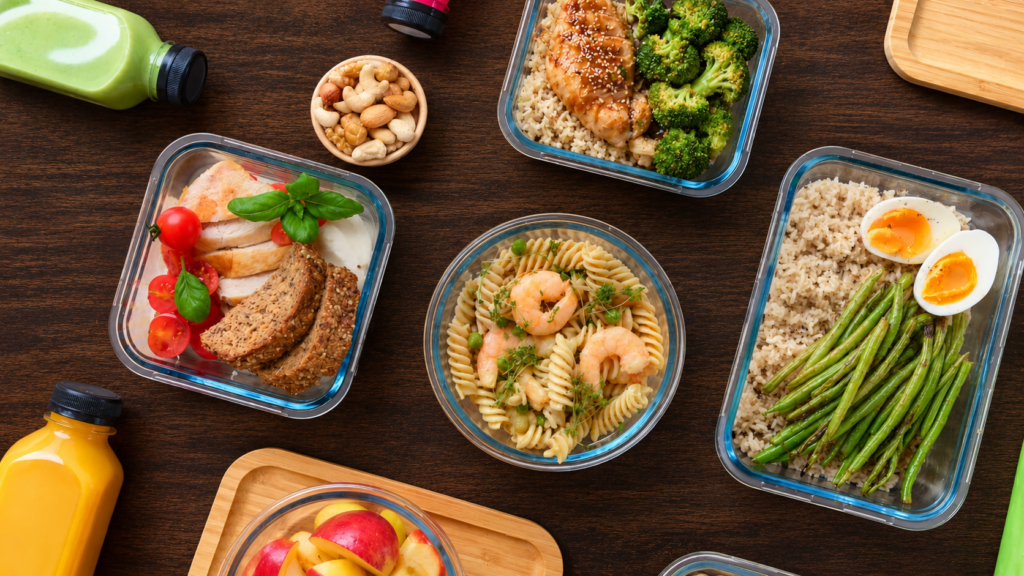
| Lunch box | Protein | Calories | Protein Score | Best eaten |
|---|---|---|---|---|
| 1. Sesame chicken, brown rice & broccoli | 44 g | About 530 kcal | B (8.3 g per 100 kcal) | Tuesday (+1 frozen for Friday) |
| 2. Chicken caprese box with seeded bread | 42 g | About 505 kcal | B (8.3 g) | Wednesday |
| 3. Lemon garlic shrimp pasta with peas | 40 g | About 435 kcal | B (9.2 g) | Monday |
| 4. Egg, edamame & green bean rice box | 35 g | About 550 kcal | C (6.4 g) | Thursday |
Protein Score is the grams of protein you get for every 100 calories: A = 10 g or more, B = 7 g or more, C = 5 g or more. Nutrition is estimated per box from USDA FoodData Central [1] and will vary with your brands and portions. How we calculate our numbers.
Looking for dinners instead? My high-protein meal prep for the week has four lunch and dinner recipes. This guide focuses only on lunches you take to work or school.
What makes a good meal prep lunch box
A lunch box has a harder job than a dinner plate. It has to survive a commute, a few days in the fridge and, often, no microwave at all. These are the rules I used to build the four boxes:
- One clear protein per box, at least 30 g. Chicken, shrimp, eggs and fresh mozzarella do the heavy lifting.
- A carb that holds up. Brown rice, short pasta like fusilli and dense seeded bread stay pleasant for days. Long noodles and soft white bread don’t.
- Sturdy vegetables. Broccoli, green beans, peas and cherry tomatoes keep their texture. Leafy salads wilt.
- Wet things kept apart. Dressings, juicy tomatoes and bread go in a separate small container or bag so nothing gets soggy.
- Different flavors. Sesame-soy, Italian caprese, lemon-garlic and a simple soy-sesame egg bowl. Eating the same thing five days in a row is the fastest way to quit meal prep.
Why planning lunch ahead works
As a psychologist, this is the part I find most interesting. In a classic experiment with 200 office workers in Amsterdam, people chose between fruit and junk food like chocolate bars and chips. When they chose a snack to receive a week later, they picked fruit far more often than when they chose a snack to eat right away [2]. Psychologists call this being “dynamically inconsistent”: your future self gets the healthy plan, your present self wants the candy bar.
The same study found a second detail that matters for meal prep: people who were hungry while choosing picked more junk food, even for the following week. The practical lesson is simple. Plan your lunches and write your shopping list after a meal, not before. Then, when Wednesday’s hungry, tired version of you opens the fridge, the decision has already been made by a calmer, fuller one.
Planning also seems to pay off over time. In a study of more than 40,000 French adults, people who planned their meals had better diet quality and more food variety. Women who planned were 21% less likely to have obesity, and men 19% less likely [3]. The study was observational, so it can’t prove that planning causes these differences, but it fits what many people notice: when the healthy option is already in the fridge, it’s the one you eat.
Lunch box 1: Sesame chicken, brown rice & broccoli
This is the anchor of the week. You make two: one for Tuesday and one for the freezer, so Friday’s lunch is already done. Roasted chicken breast is tossed in a quick sesame-soy glaze, then packed with brown rice and roasted broccoli and finished with sesame seeds.
| Per box | Amount |
|---|---|
| Cooked chicken breast | About 3¾ oz (from 5 oz raw) |
| Cooked brown rice | ¾ cup |
| Roasted broccoli | 1½ cups |
| Sesame glaze | 1 tbsp soy sauce, 1 tsp honey, 1 tsp sesame oil, 1 tsp sesame seeds |
| Nutrition | 44 g protein · 530 kcal · 8 g fiber |
Reheat: 2 minutes in the microwave with a loose lid, stirring halfway. It’s also good at room temperature like a rice bowl.
Lunch box 2: Chicken caprese box with seeded bread
The no-microwave option. Sliced chicken breast from the same batch, fresh mozzarella, cherry tomatoes and basil with a drizzle of olive oil and balsamic, plus two slices of dense seeded bread on the side. It works like a build-your-own open sandwich at your desk.
| Per box | Amount |
|---|---|
| Cooked chicken breast, sliced | 3 oz (from about 4 oz raw) |
| Fresh mozzarella | 1½ oz |
| Cherry tomatoes | 1 cup, halved |
| Seeded whole-grain or rye bread | 2 slices |
| Dressing | 1 tsp olive oil + 1 tsp balsamic vinegar, basil leaves |
| Nutrition | 42 g protein · 505 kcal · 7 g fiber |
Pack smart: keep the bread in a separate bag and the dressing in a tiny jar. Add them right before eating.
Lunch box 3: Lemon garlic shrimp pasta with peas
Shrimp is one of the leanest proteins you can buy, and it cooks in about three minutes. Here it’s tossed with fusilli, sweet peas, garlic, lemon and a little Parmesan, then topped with microgreens. Short, twisted pasta like fusilli holds the sauce and doesn’t clump in the fridge like spaghetti.
| Per box | Amount |
|---|---|
| Cooked shrimp | About 4 oz (from 5 oz raw, peeled) |
| Fusilli | 2 oz dry (about 1 cup cooked) |
| Peas | ½ cup |
| Sauce | 1 tsp olive oil, 1 garlic clove, lemon juice and zest, 1 tbsp Parmesan |
| Nutrition | 40 g protein · 435 kcal · 6 g fiber |
Why Monday: seafood tastes best fresh, so this is the first box you eat. It’s great cold, like a pasta salad.
Lunch box 4: Egg, edamame & green bean rice box
A vegetarian box built around eggs. Three eggs, brown and wild rice mixed with shelled edamame, and a big pile of green beans, finished with a teaspoon each of soy sauce and sesame oil. The edamame isn’t just for color: half a cup adds about 9 g of protein.
| Per box | Amount |
|---|---|
| Hard-cooked eggs | 3 large |
| Cooked brown or brown & wild rice | ½ cup |
| Shelled edamame | ½ cup |
| Green beans | 1½ cups, cooked |
| Dressing | 1 tsp soy sauce + 1 tsp sesame oil |
| Nutrition | 35 g protein · 550 kcal · 12 g fiber |
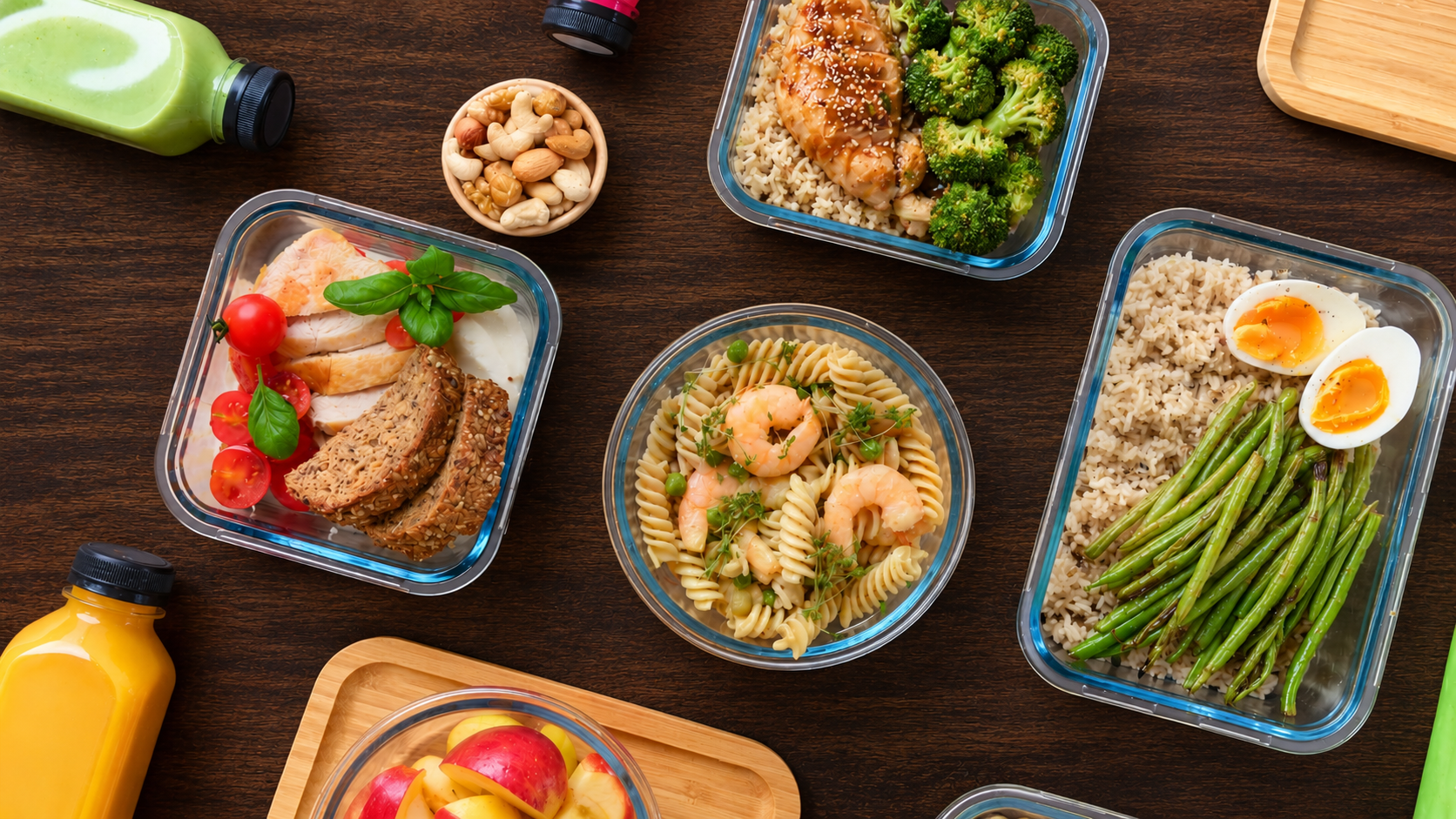
About the eggs: the photo shows jammy eggs, which look beautiful, but for meal prep the FDA recommends cooking eggs until both the yolk and the white are firm. Hard-cooked eggs keep for up to 1 week in the fridge, which is exactly why this box is saved for Thursday [4].
This box has the lowest Protein Score of the four (C) because eggs and rice bring more calories per gram of protein than chicken or shrimp. Want it higher? Swap one whole egg for ½ cup of liquid egg whites scrambled into the rice.
High-protein meal prep lunch boxes recipe
Everything for 5 lunches in one session: two sesame chicken boxes (one to freeze) and one of each of the other three. The recipe card below shows the average nutrition per box.
High-Protein Meal Prep Lunch Boxes
Ingredients
Method
- Preheat the oven to 425°F (220°C). Cook the rice according to the package directions.
- Rub the chicken with olive oil, garlic powder, salt and pepper and place it on a sheet pan. Spread the broccoli on a second sheet pan with a pinch of salt. Roast the broccoli for 15–18 minutes and the chicken for 18–22 minutes, until it reaches 165°F (74°C) inside.
- Meanwhile, place the eggs in boiling water and cook for 10 minutes, until the yolk and white are firm. Transfer to ice water, then peel.
- Cook the fusilli in salted water, adding the peas for the last 2 minutes. In another pot, boil the green beans and edamame for 4–5 minutes. Drain everything.
- Heat 1 tsp olive oil in a skillet over medium-high heat. Add the garlic and shrimp and cook for 2–3 minutes, until the shrimp are pink and opaque. Toss with the pasta and peas, lemon juice and zest, and Parmesan.
- Slice the chicken. Mix the soy sauce, honey and sesame oil, and toss with about two-thirds of the chicken (10 oz raw weight). Keep the rest plain for the caprese box.
- Spread the food on trays or in shallow containers to cool, and refrigerate within 2 hours of cooking.
- Pack the boxes: 2 sesame chicken boxes with ¾ cup rice, 1½ cups broccoli and sesame seeds each; 1 caprese box with chicken, mozzarella, tomatoes, basil, and the dressing and bread packed separately; 1 shrimp pasta box; 1 egg box with ½ cup rice mixed with the edamame, the green beans, 3 eggs, and the soy sauce and sesame oil.
- Refrigerate the boxes and eat them within 3–4 days: shrimp pasta on Monday, sesame chicken on Tuesday, caprese on Wednesday and the egg box on Thursday. Freeze the second sesame chicken box for Friday and thaw it in the fridge the night before.
Notes
Your 75-minute prep timeline
| Time | What to do |
|---|---|
| 0:00 | Preheat the oven to 425°F. Start the rice. |
| 0:05 | Season the chicken and put it in the oven with the broccoli on a second sheet pan. |
| 0:10 | Boil the eggs for 10 minutes, then move them to ice water. |
| 0:25 | Cook the pasta, adding the peas for the last 2 minutes. Cook the green beans and edamame. |
| 0:35 | Take out the broccoli. Check the chicken: it’s done at 165°F inside. |
| 0:40 | Sauté the shrimp with garlic. Toss with the pasta, lemon and Parmesan. |
| 0:50 | Slice the chicken, glaze part of it and spread everything on trays to cool. |
| 1:05 | Pack the boxes, label them with the day, and get them in the fridge. |
Food safety: the 4-day rule
Most cooked leftovers, including chicken, shrimp, rice and pasta, keep for 3–4 days in the fridge, according to the USDA [5]. That’s why this plan covers Monday to Thursday from the fridge and Friday from the freezer.
- Cool food quickly. Get everything into the fridge within 2 hours of cooking. Spreading food on a tray or using shallow containers helps it cool faster [5].
- Freeze for later. Frozen leftovers stay safe indefinitely, but taste best within 3–4 months [5]. Thaw Friday’s box in the fridge on Thursday night.
- Reheat until steaming hot. The USDA recommends reheating leftovers to 165°F [5].
- Use an insulated bag with an ice pack if your lunch sits outside a fridge for more than a couple of hours.
What happens to rice in the fridge
Here’s a fun bonus of meal prep. When cooked rice cools, part of its starch reorganizes into resistant starch, a type of starch that behaves more like fiber: you don’t digest it in the small intestine, and it reaches your colon, where your gut bacteria can ferment it.
In a study from Indonesia, white rice that was cooked, cooled in the fridge for 24 hours and then reheated had about 2.5 times more resistant starch than freshly cooked rice (1.65 vs 0.64 g per 100 g). In 15 healthy adults, the cooled-and-reheated rice also led to a lower blood sugar response [6]. It was a small study with white rice, and the effect is modest, so think of it as a nice extra rather than a magic trick.
Count how many different plants fit into a simple week of lunch boxes: rice, wild rice, broccoli, green beans, peas, edamame, tomatoes, basil, garlic, lemon, sesame, wheat and seeds. Variety is one of the easiest ways to feed different gut bacteria.
Snacks and drinks to pack
The photo also shows what goes around the boxes: a small bowl of nuts, sliced apples and bottled juices. A few honest notes:
- Nuts: a 1 oz handful of mixed nuts has about 5 g of protein and roughly 170 calories [1]. Pre-portion them so the bag doesn’t disappear in one afternoon.
- Fruit: whole apples beat apple juice because you keep the fiber. Toss sliced apples with a little lemon juice so they don’t turn brown.
- Drinks: juices and green smoothies add sugar and calories without much protein. If you want a protein drink, try my iced protein coffee or a shake with milk. Otherwise, water is the best partner for these boxes.
Common mistakes
- Prepping too far ahead. A Sunday prep can’t safely cover Saturday. Use the freezer for days 5 and beyond.
- Overcooking the shrimp. Take them off the heat as soon as they turn pink and opaque. They’ll reheat slightly at lunch.
- Packing everything hot. Warm food in closed containers cools slowly and steams the vegetables. Let it cool on trays first, but no longer than 2 hours.
- Undersizing the protein. A few slices of chicken on a mountain of rice won’t keep you full until dinner. Weigh the protein the first time.
Frequently asked questions
How long do meal prep lunch boxes last in the fridge?
Most cooked meal prep lunches last 3–4 days in the fridge. Hard-cooked eggs last up to 1 week. For a fifth day, freeze a box.
Can I eat these lunches cold?
Yes. The caprese box and the shrimp pasta are designed to be eaten cold. The sesame chicken and egg boxes are good cold or reheated.
Are glass or plastic containers better for meal prep?
Both work. Glass containers like the ones in the photo don’t stain or hold smells and can go in the oven, but they’re heavier to carry. If you use plastic, look for containers labeled microwave-safe.
How much protein should a lunch have?
For most adults, 30–40 g at lunch is a practical target that helps spread protein across the day. My daily protein guide shows how to calculate your total, and my high-protein breakfast guide covers the first meal of the day.
Can I make this plan vegetarian?
Yes. Keep box 4, swap the chicken for baked tofu in box 1 (see my crispy tofu with broccoli and rice), and use extra mozzarella and white beans in the caprese box.
Sources
- USDA Agricultural Research Service. FoodData Central. fdc.nal.usda.gov
- Read D, van Leeuwen B. Predicting hunger: the effects of appetite and delay on choice. Organ Behav Hum Decis Process. 1998;76(2):189–205. PubMed
- Ducrot P, Méjean C, Aroumougame V, et al. Meal planning is associated with food variety, diet quality and body weight status in a large sample of French adults. Int J Behav Nutr Phys Act. 2017;14:12. PMC
- U.S. Food and Drug Administration. Playing It Safe With Eggs. fda.gov
- USDA Food Safety and Inspection Service. Leftovers and Food Safety. fsis.usda.gov
- Sonia S, Witjaksono F, Ridwan R. Effect of cooling of cooked white rice on resistant starch content and glycemic response. Asia Pac J Clin Nutr. 2015;24(4):620–625. PubMed
This article is for general information and is not medical advice. Nutrition values are estimates and vary with the brands and portions you use.