
Overnight oats are the breakfast I make when I know the morning is going to be busy. Five minutes the night before, a jar in the fridge, and breakfast is ready when I wake up. The problem is that most overnight oats recipes are mostly oats, milk and fruit, with only 10–12 grams of protein. That’s why I’m hungry again by mid-morning.
Prefer it warm? These overnight oats are a no-cook, make-ahead breakfast that you eat cold. If you want a hot bowl cooked in a few minutes in the morning, with or without protein powder, see my protein oatmeal two ways.
This high-protein version fixes that. A mix of Greek yogurt, milk and a little protein powder gives you about 36 grams of protein per jar, and the texture is thick and creamy, like cheesecake filling. Below you’ll find my base recipe, the simple ratio I use for any flavor, five flavor ideas and a version without protein powder.
| Protein | Calories | Prep time | Protein Score |
|---|---|---|---|
| 36 g per jar | About 430 kcal | 5 min (+ overnight) | B (8.4 g per 100 kcal) |
Why overnight oats work so well
When rolled oats soak in liquid overnight, they soften and absorb it slowly, so you get a creamy, pudding-like texture without cooking anything. Rolled oats are already steamed and flattened during processing, which is why they’re safe and pleasant to eat without heating.
They’re also one of the easiest breakfasts to meal prep. You can make four or five jars on Sunday, grab one each morning, and eat it at home, at work or after the gym. Because they’re served cold, they’re great on warm days, but you can also microwave them if you prefer warm oats.
Oats are rich in beta-glucan, a soluble fiber. A meta-analysis of randomized controlled trials found that eating at least 3 g of oat beta-glucan per day lowered LDL cholesterol compared with control diets [1]. Adding protein makes the jar more filling too: higher-protein meals tend to increase fullness compared with lower-protein ones in controlled studies [2]. Plain Greek yogurt is one of the easiest ways to add it, with about 10 g of protein per 100 g [3].
The simple ratio for any flavor
Once you know this ratio, you can make overnight oats with whatever you have in the fridge. For one jar:
| Part | Amount | Why |
|---|---|---|
| Rolled oats | ½ cup (40 g) | The base. Gives fiber and slow-digesting carbs. |
| Greek yogurt | ½ cup (120 g) | Protein and that creamy, thick texture. |
| Milk | ½ cup (120 ml) | Softens the oats. Add a splash more if you like it looser. |
| Protein powder | ½ scoop (15 g) | Adds about 12 g of protein without making it chalky. |
| Chia seeds | 1 tbsp | Thickens the mix and adds fiber and omega-3 fats. |
If you add more protein powder, add 2–3 tablespoons of extra milk too. Powder absorbs a lot of liquid, and without it the oats turn stiff and dry.
What each ingredient does
- Rolled oats, not quick or steel-cut. Quick oats turn mushy and steel-cut oats stay too hard after one night. Old-fashioned rolled oats have the best texture.
- Plain nonfat Greek yogurt. It gives the most protein for the calories. Flavored yogurts usually have a lot of added sugar.
- Any milk. Skim, 2%, soy or a protein milk all work. Soy and protein milks add a few extra grams of protein.
- Vanilla protein powder. Whey, casein or a blend all work. Casein makes the oats extra thick.
- Chia seeds. Optional, but they make the texture creamier and help it set.
- Fruit. Raspberries are my favorite because they melt slightly into the oats overnight.
High-protein overnight oats recipe
This makes 1 jar. To meal prep, use the servings button in the recipe card to make 4 or 5 at once.
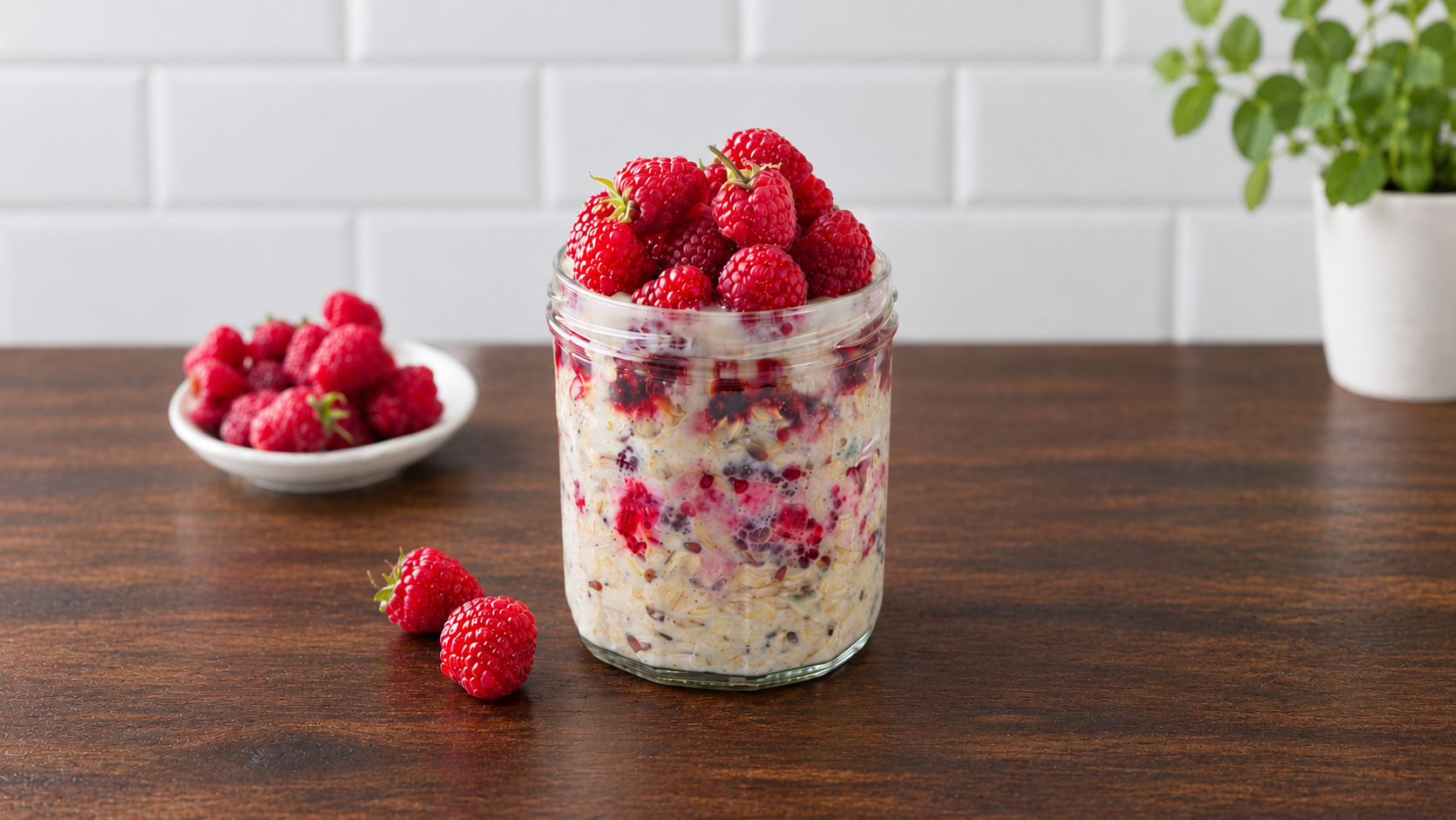
High-Protein Overnight Oats
Ingredients
Method
- Add the oats, Greek yogurt, milk, protein powder, chia seeds, maple syrup, vanilla and salt to a jar or container.
- Stir very well until there are no dry pockets of protein powder left.
- Gently fold in the raspberries, or layer them on top.
- Cover and refrigerate for at least 4 hours, or overnight.
- In the morning, stir, add a splash of milk if it’s too thick, and top with fresh raspberries.
Notes
5 flavors to try
Start with the base recipe and change only the fruit and flavorings. All values are per jar.
| Flavor | What to change | Per jar |
|---|---|---|
| Raspberry vanilla (recipe card) | ½ cup raspberries | About 430 kcal, 36 g protein |
| Chocolate | Use chocolate protein powder and add 1 tbsp cocoa powder | About 440 kcal, 37 g protein |
| Peanut butter banana | Swap the raspberries for ½ sliced banana and stir in 1 tbsp peanut butter | About 545 kcal, 40 g protein |
| Apple pie | Swap the raspberries for ½ diced apple and add ½ tsp cinnamon | About 445 kcal, 36 g protein |
| Strawberry cheesecake | Use cottage cheese instead of Greek yogurt and top with sliced strawberries | About 450 kcal, 36 g protein |
If you love the cheesecake flavor, my cottage cheese ice cream uses the same trick in dessert form.
Without protein powder
You don’t need protein powder to make high-protein overnight oats. Skip it and use ¾ cup (180 g) of Greek yogurt instead of ½ cup, plus ¼ cup of milk. You’ll get about 24–26 g of protein per jar. Using soy milk or a protein milk instead of regular milk adds a few more grams.
Prefer hot oatmeal? My protein oatmeal article has two cooked versions, with and without protein powder.
Meal prep and storage
- Use jars or containers with lids. 12–16 oz mason jars are the perfect size and leave room for toppings.
- Fridge: overnight oats keep well for up to 4 days, so make them for the first half of the week. Keep them cold and covered [4].
- Add crunchy toppings in the morning. Nuts, granola and seeds go soft overnight.
- Eat them warm if you like. Microwave for 1–2 minutes, stirring halfway, and add a splash of milk.
Overnight oats are perfect alongside my high-protein meal prep plan: breakfast and lunch are done in one Sunday session.
Common mistakes to avoid
- Using too little liquid. Oats, chia and protein powder all absorb liquid. If it’s too thick in the morning, stir in a splash of milk.
- Adding too much protein powder. More than a full scoop per jar makes them chalky. Get the rest of the protein from yogurt.
- Not stirring well. Mix everything until there are no dry pockets of powder at the bottom.
- Eating them after only an hour. They need at least 4 hours, and overnight is best.
Frequently asked questions
How much protein is in overnight oats?
Regular overnight oats with just oats and milk have about 10–12 g of protein. This version with Greek yogurt and half a scoop of protein powder has about 36 g per jar.
Can you eat overnight oats warm?
Yes. Microwave them for 1–2 minutes, stirring halfway, and add a splash of milk if they’re too thick.
How long do overnight oats last in the fridge?
Up to 4 days in a covered container. Add fresh fruit and crunchy toppings the day you eat them for the best texture.
Can I make overnight oats without chia seeds?
Yes. Chia seeds make them thicker, but you can skip them and use 2 tablespoons less milk.
Are overnight oats good for weight loss?
They can be part of a weight-loss diet because they’re filling, high in fiber and easy to portion. Watch the extras: nut butter, granola and syrup add calories quickly.
Sources
- Whitehead A, Beck EJ, Tosh S, Wolever TM. Cholesterol-lowering effects of oat β-glucan: a meta-analysis of randomized controlled trials. Am J Clin Nutr. 2014;100(6):1413–1421. PubMed
- Westerterp-Plantenga MS, Nieuwenhuizen A, Tomé D, Soenen S, Westerterp KR. Dietary protein, weight loss, and weight maintenance. Annu Rev Nutr. 2009;29:21–41. Annual Reviews
- USDA Agricultural Research Service. FoodData Central. fdc.nal.usda.gov
- USDA Food Safety and Inspection Service. Leftovers and Food Safety. fsis.usda.gov
This article is for general information and is not medical advice. Nutrition values are estimates and vary with the yogurt, milk and protein powder you use.