
Cheesecake is one of those desserts I never want to give up, so I made a version I can enjoy any day of the week. This protein cheesecake is made with blended cottage cheese, Greek yogurt and a little light cream cheese, so every slice has about 19 grams of protein. It bakes until the top turns deep golden, and the inside stays creamy and tangy.
Below you’ll find why cottage cheese works so well in cheesecake, how to get that golden top, the best fruit to serve with it, a little gut-health science, and why allowing yourself dessert can actually help you eat better.
| Protein | Calories | Time | Protein Score |
|---|---|---|---|
| About 19 g per slice | About 220 kcal | 15 min prep + 40 min bake + chilling | B (8.6 g per 100 kcal) |
Protein Score is the grams of protein per 100 calories. Nutrition is estimated from USDA FoodData Central [1]. How we calculate our numbers.
Why cottage cheese makes a great cheesecake
A classic New York cheesecake uses about 2 pounds of full-fat cream cheese, plus sugar and cream. It’s delicious, but most of the calories come from fat, with only around 6 g of protein per slice. Cottage cheese changes that balance:
- More protein, much less fat. A cup of 2% cottage cheese has about 24 g of protein and around 180 calories, while the same amount of regular cream cheese has only about 14 g of protein and more than 800 calories [1].
- Blended, it’s silky. The curds disappear completely after 1–2 minutes in a blender, and nobody can tell it’s cottage cheese.
- A little cream cheese stays. Just 4 oz of light cream cheese keeps the dense, classic cheesecake texture.
- Greek yogurt and vanilla protein add more protein and help the filling set.
An honest note: cottage cheese is salty, with roughly 700 mg of sodium per cup [1]. Spread over 8 slices it’s modest, but if you watch your salt, look for a lower-sodium brand.
Cottage cheese isn’t just a diet food anymore. In the U.S., cottage cheese sales grew 16% in a single year, to about $1.3 billion, partly thanks to viral recipes on social media [2]. If you’re curious about other ways to use it, try my cottage cheese ice cream.
The secret to the golden top
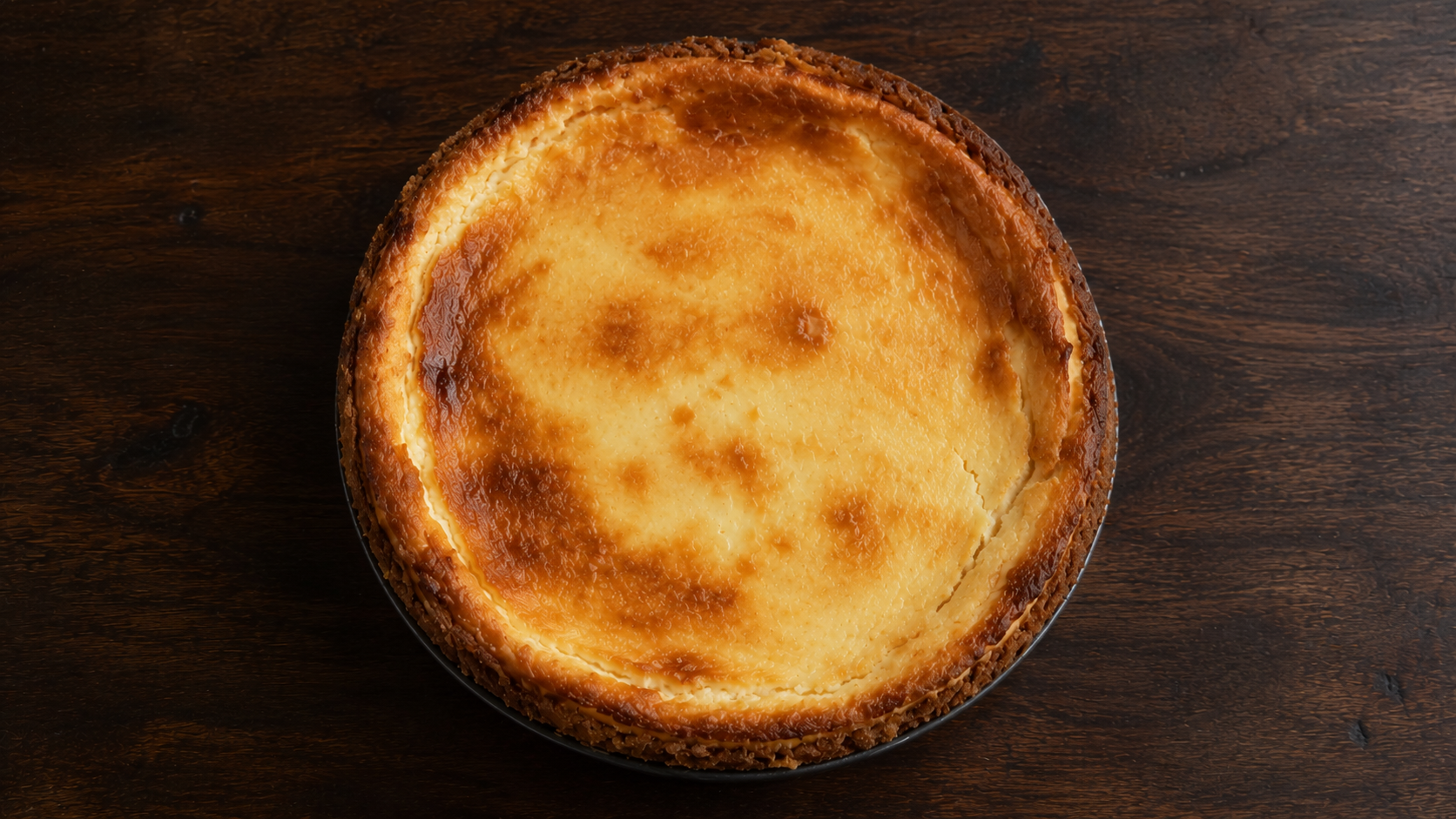
Most cheesecakes are baked low and slow in a water bath to keep the top pale and smooth. This one does the opposite: it bakes at a higher temperature without a water bath, so the top caramelizes into a deep golden color, like in the photo. The browning comes from the Maillard reaction, the same chemistry that browns toast and seared meat, where proteins and sugars react with heat. A high-protein filling browns especially well.
This style was inspired by the famous “burnt” Basque cheesecake, created in the late 1980s by chef Santiago Rivera at La Viña, a pintxo bar in San Sebastián, Spain [3]. It’s supposed to look rustic. A few cracks and dark spots are part of the charm, so don’t worry about a perfect surface.
The best fruit to serve with it
The golden top looks beautiful on its own, but fresh fruit on the side adds color, freshness and natural sweetness for very few calories. Approximate values from USDA data [1]:
| Fruit | Serving | Calories | Fiber | Vitamin C | Why I love it |
|---|---|---|---|---|---|
| Strawberries | 1 cup, halved | About 50 | 3 g | About 89 mg (≈100% DV) | The classic: sweet, juicy and great as a quick sauce |
| Raspberries | 1 cup | About 64 | 8 g | About 32 mg | The most fiber of any common berry |
| Blueberries | 1 cup | About 84 | 3.6 g | About 14 mg | Rich in anthocyanins, the pigments behind their deep color |
| Kiwi | 1 medium | About 42 | 2 g | About 64 mg | Tangy and bright, perfect with the creamy filling |
| Mango | 1 cup, diced | About 99 | 2.6 g | About 60 mg | Tropical and naturally very sweet |
| Pomegranate seeds | ½ cup | About 72 | 3.5 g | About 9 mg | Crunchy, festive and beautiful on top |
A cup of strawberries covers roughly your whole daily need for vitamin C [1], which your body needs to make collagen, the protein that gives structure to your skin, tendons and blood vessels [4].
Berries and your gut microbiota
This is the part I find most interesting, because of my training in microbiota and digestive health. Berries are rich in polyphenols, such as anthocyanins and ellagitannins. Most of them aren’t absorbed in the small intestine. Instead, they reach the colon, where your gut bacteria break them down. A review in Food & Function describes how berry polyphenols and gut microbes interact in both directions: the bacteria transform the polyphenols, and the polyphenols may encourage the growth of beneficial bacteria [5].
Research in this area is still growing, and a slice of cheesecake isn’t a gut-health treatment. But adding colorful fruit to the foods you already enjoy is an easy way to give your microbiota more to work with.
Can dessert help you eat better?
Many people try to “be good” by cutting out dessert completely, and then end up eating half a cake on Saturday. In a large study of more than 50,000 people, researchers compared two styles of dieting. Rigid control, an all-or-nothing approach with forbidden foods, was linked to a higher BMI and more frequent binge eating. Flexible control, where treats fit into an overall balanced diet, was linked to a lower BMI, less binge eating and more successful weight loss [6].
That’s the idea behind this recipe. A slice of cheesecake that you plan, enjoy and fit into your day is very different from a dessert you eat in secret and feel guilty about. And with about 19 g of protein per slice, it also keeps you satisfied longer than a regular dessert [7].
Cottage cheese protein cheesecake recipe
This makes one 8-inch cheesecake, or 8 slices. Blend the cottage cheese until it’s completely smooth: that step makes all the difference.
Cottage Cheese Cheesecake
Ingredients
Method
- Heat the oven to 350°F (175°C). Line the bottom of an 8-inch springform pan with parchment paper.
- Mix the graham cracker crumbs with the melted butter and press firmly into the bottom of the pan. Bake for 8 minutes, then let it cool slightly.
- Blend the cottage cheese in a blender or food processor for 1–2 minutes, until completely smooth with no curds left.
- Add the cream cheese, Greek yogurt, protein powder, sweetener, cornstarch, vanilla, lemon juice and zest, and blend until smooth. Add the eggs and blend briefly, just until combined.
- Pour the filling over the crust and bake for 40–45 minutes, until the top is deep golden, the edges are set and the center still jiggles slightly. For a darker top, broil for 1–2 minutes at the end, watching closely.
- Turn off the oven, open the door slightly and leave the cheesecake inside for 30 minutes. Then let it cool to room temperature and refrigerate for at least 6 hours, or overnight.
- Cut into 8 slices and serve with fresh fruit if you like.
Notes
Tips for a creamy cottage cheese cheesecake
- Blend, don’t mix. A blender or food processor is a must. Blend the cottage cheese for 1–2 minutes, until there are no curds left.
- Room-temperature ingredients blend more smoothly and bake more evenly.
- Look for the wobble. It’s ready when the top is deep golden, the edges are set and the center still jiggles slightly.
- Want it darker? Broil it for 1–2 minutes at the end, watching it closely.
- Chill it well. At least 6 hours in the fridge, or overnight. Cottage cheese cheesecake firms up a lot as it chills.
Variations
| Version | What to change |
|---|---|
| Lemon | Add the zest of 2 lemons to the filling and serve with blueberries or kiwi. |
| Chocolate | Use chocolate protein powder and add 2 tbsp unsweetened cocoa powder. Serve with raspberries. |
| Crustless | Skip the crust and grease and line the pan with parchment, like the original Basque style. |
| Mini cheesecakes | Bake in a lined muffin tin at 350°F for 18–22 minutes. |
Storage
- Fridge: keep it covered for up to 4 days. Add fresh fruit just before serving.
- Freezer: freeze plain slices, wrapped individually, for up to 1 month. Thaw overnight in the fridge.
Frequently asked questions
Does cottage cheese cheesecake taste like cottage cheese?
Not if you blend it until completely smooth. It tastes like a light, slightly tangy classic cheesecake.
How much protein is in this cheesecake?
About 19 g of protein and 220 calories per slice, with the cake cut into 8 slices.
Can I make it without protein powder?
Yes. Replace the protein powder with another ¾ cup of cottage cheese and 1 more tablespoon of cornstarch. Each slice will have about 16 g of protein.
Which cottage cheese should I use?
2% cottage cheese gives the best balance of creaminess and protein. Full-fat works too and makes it richer. Nonfat can make the filling a bit watery.
Which sweetener should I use?
Any granulated sweetener that measures like sugar works. The nutrition is calculated with a zero-calorie sweetener; using regular sugar adds about 32 calories per slice.
Sources
- USDA Agricultural Research Service. FoodData Central. fdc.nal.usda.gov
- Berk B. TikTok drives astronomical sales for cottage cheese (Circana data, 52 weeks ending Feb. 25, 2024). Dairy Foods. May 3, 2024. dairyfoods.com
- Basque cheesecake. Wikipedia. wikipedia.org
- Abdullah M, Jamil RT, Attia FN. Vitamin C (Ascorbic Acid). In: StatPearls. StatPearls Publishing; updated 2023. NCBI Bookshelf
- Lavefve L, Howard LR, Carbonero F. Berry polyphenols metabolism and impact on human gut microbiota and health. Food Funct. 2020;11(1):45–65. RSC
- Westenhöfer J, Stunkard AJ, Pudel V. Validation of the flexible and rigid control dimensions of dietary restraint. Int J Eat Disord. 1999;26(1):53–64. HAW Hamburg
- Leidy HJ, Clifton PM, Astrup A, et al. The role of protein in weight loss and maintenance. Am J Clin Nutr. 2015;101(6):1320S–1329S. PubMed
This article is for general information and is not medical advice. Nutrition values are estimates and vary with the brands of cottage cheese, yogurt and protein powder you use.