
If there’s one meal where most of us fall short on protein, it’s breakfast. Coffee and toast, a bowl of cereal, a pastry on the way to work: they’re quick, but they barely move the needle. Then dinner arrives with a big plate of chicken or steak, and we try to catch up all at once.
In this guide I’ll show you what the research says about eating more protein in the morning, why it may help with cravings later in the day, a simple psychology trick to make it a habit, and 15 easy breakfast ideas with 20–40 g of protein each.
| Quick answer | |
|---|---|
| How much protein at breakfast? | About 25–35 g for most adults |
| Why? | It helps spread protein across the day, keeps you fuller and may reduce evening cravings |
| Easiest sources | Eggs, Greek yogurt, cottage cheese, protein oats, smoked salmon, tofu, protein shakes |
The typical breakfast problem
Americans eat most of their protein at dinner. National survey data show that adults eat about 38 g of protein at dinner on average, roughly three times more than the 13 g they eat at breakfast [1]. A slice of toast with butter and a coffee with a splash of milk might give you 5 g. Even a bowl of cereal with milk usually stays around 8–10 g.
That’s a problem if you want to build or keep muscle, because your body can’t store protein for later the way it stores fat. If you want a refresher on how much you need in total, read my guide on how much protein you need a day.
Spread your protein through the day
In a crossover study published in the Journal of Nutrition, adults ate the same total amount of protein, about 90 g a day, in two different ways. In one week, it was spread evenly: about 30 g at breakfast, lunch and dinner. In the other, it was skewed: about 11 g at breakfast, 16 g at lunch and 63 g at dinner. With the even pattern, muscle protein synthesis over 24 hours was about 25% higher [1].
It was a small study with 8 adults, so it’s not the final word. But the message is practical: moving some of your dinner protein to breakfast is an easy change that may help your muscles make better use of it.
Protein at breakfast, fewer cravings at night
One of my favorite studies on this topic looked at 20 young women aged 18 to 20 who usually skipped breakfast. On different days they skipped breakfast, ate a cereal breakfast, or ate a high-protein breakfast of eggs and lean beef with 35 g of protein. All breakfasts had the same calories. The high-protein breakfast increased fullness, reduced brain activity linked to food cravings measured with fMRI before dinner, and led to less evening snacking on high-fat and high-sugar foods [2].
As a psychologist, I find this fascinating: what you eat at 8 a.m. may change how much you want chips at 9 p.m. The study was small and only included young women, so more research is needed, but it fits what many people notice in real life. Protein is also the most filling macronutrient in general [3].
Make it a habit with an “if-then” plan
Knowing that a protein breakfast is good for you isn’t the hard part. Doing it on a busy Tuesday is. Psychologists have a simple tool for this called an implementation intention, or “if-then” plan. Instead of a vague goal like “I’ll eat more protein,” you decide exactly when and how: “If it’s a weekday morning, then I’ll have Greek yogurt with berries.” A meta-analysis of 94 studies found that this kind of planning has a medium-to-large effect on reaching goals [4].
Here’s how to write yours:
- Pick the trigger: “When I turn on the coffee machine…”
- Pick one default breakfast: “…I’ll make my overnight oats or two eggs with cottage cheese toast.”
- Prepare the night before: a jar of overnight oats or a few hard-boiled eggs remove the decision in the morning.
15 high-protein breakfast ideas
Protein values are approximate, based on USDA data [5] and typical labels. Mix and match to reach about 25–35 g.
| Breakfast | Approx. protein | Time |
|---|---|---|
| High-protein overnight oats | 36 g | 5 min the night before |
| High-protein omelette | 43 g | 10 min |
| Protein oatmeal, two ways | See recipe | 5 min |
| Protein pancakes | See recipe | 15 min |
| Greek yogurt bowl: 1 cup nonfat Greek yogurt + berries + 2 tbsp nuts | About 27 g | 2 min |
| Cottage cheese toast: ½ cup cottage cheese on 2 slices whole-grain toast + tomato | About 20 g | 5 min |
| 2 eggs + ½ cup egg whites scrambled, with toast | About 29 g | 8 min |
| Protein smoothie: 1 scoop whey + 1 cup milk + banana + spinach | About 32 g | 5 min |
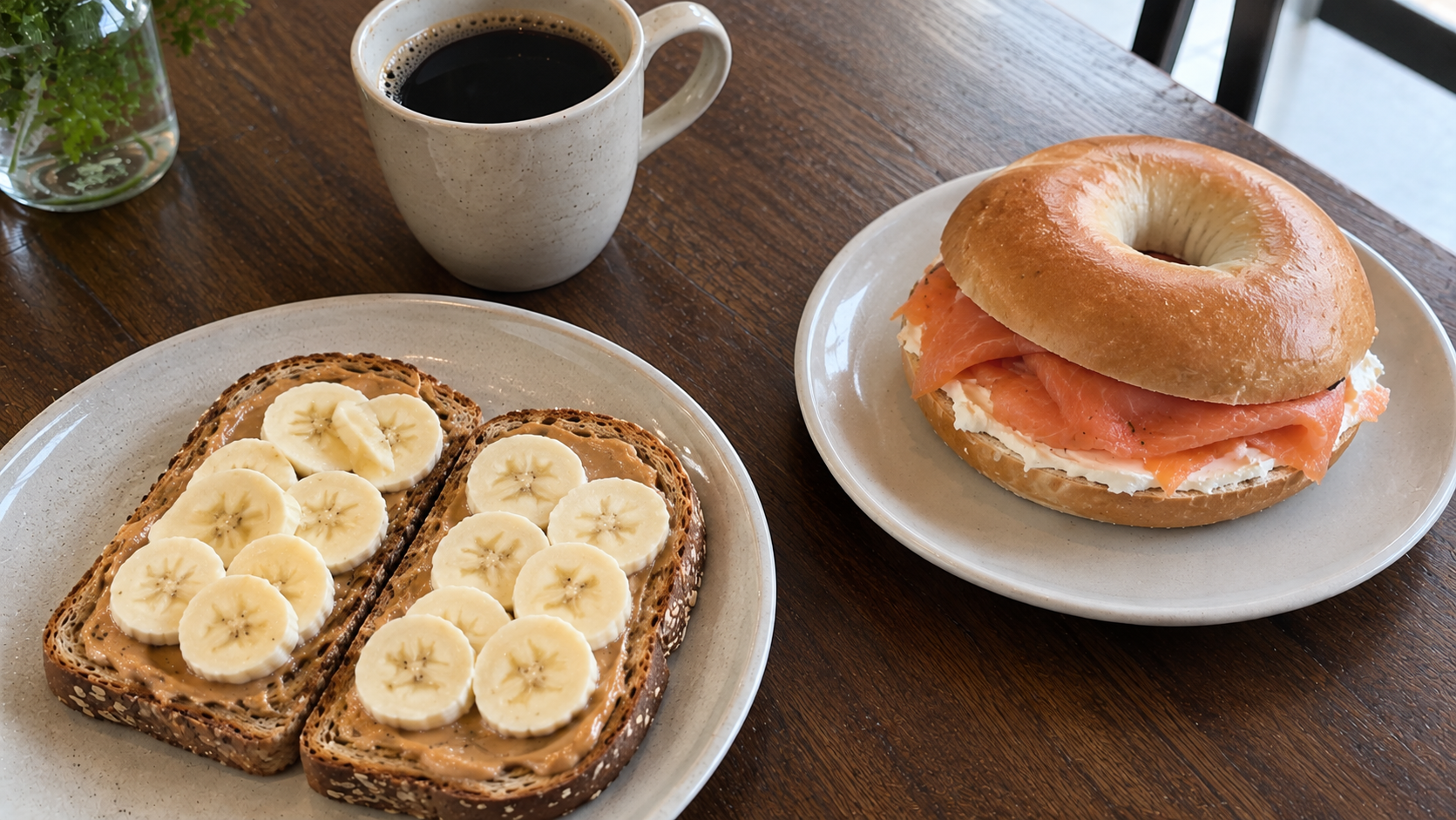
| Smoked salmon bagel: 3 oz salmon + whole-wheat bagel + light cream cheese | About 28 g | 5 min |
| Breakfast burrito: 2 eggs + ¼ cup black beans + 1 oz cheese in a tortilla | About 26 g | 10 min |
| Tofu scramble: 7 oz extra-firm tofu with veggies + 1 slice toast | About 24 g | 10 min |
| Egg muffin cups (make ahead): 3 muffins with egg, turkey and spinach | About 25 g | Prep once, 2 min to reheat |
| Cottage cheese bowl: 1 cup cottage cheese + pineapple or peaches | About 25 g | 2 min |
| Peanut butter protein toast: 2 slices toast + 2 tbsp peanut butter + a glass of milk | About 23 g | 3 min |
| Coffee + a protein boost: my iced protein coffee with a hard-boiled egg | About 31 g | 3 min |
Common mistakes
- Relying on “protein” cereal or bars. Many have only 8–12 g of protein and a lot of added sugar. Check the label.
- Only adding protein, not volume. Fruit, vegetables and whole grains make breakfast more filling and add fiber.
- Making it complicated. One or two default breakfasts you actually like work better than a different recipe every day.
- Forgetting the rest of the day. A big breakfast doesn’t replace protein at lunch and dinner. Aim for a balance.
Frequently asked questions
Is 30 g of protein for breakfast too much?
No. For most adults, 25–35 g at breakfast is a reasonable amount and helps spread protein evenly across the day.
What if I’m not hungry in the morning?
Start small: a Greek yogurt, a glass of milk with a protein coffee, or a couple of eggs. Your appetite in the morning often adapts when you eat breakfast regularly.
Is a protein shake a good breakfast?
It can be, especially on busy days. Blend it with milk, fruit and a handful of spinach or oats so it’s a real meal, not just a drink.
What’s the best high-protein breakfast for weight loss?
One that you enjoy and can repeat: something with 25–35 g of protein plus fiber, like Greek yogurt with berries and nuts, or eggs with vegetables and whole-grain toast.
Sources
- Mamerow MM, Mettler JA, English KL, et al. Dietary protein distribution positively influences 24-h muscle protein synthesis in healthy adults. J Nutr. 2014;144(6):876–880. PMC
- Leidy HJ, Ortinau LC, Douglas SM, Hoertel HA. Beneficial effects of a higher-protein breakfast on the appetitive, hormonal, and neural signals controlling energy intake regulation in overweight/obese, “breakfast-skipping,” late-adolescent girls. Am J Clin Nutr. 2013;97(4):677–688. ScienceDaily
- Leidy HJ, Clifton PM, Astrup A, et al. The role of protein in weight loss and maintenance. Am J Clin Nutr. 2015;101(6):1320S–1329S. PubMed
- Gollwitzer PM, Sheeran P. Implementation intentions and goal achievement: a meta-analysis of effects and processes. Adv Exp Soc Psychol. 2006;38:69–119. University of Konstanz
- USDA Agricultural Research Service. FoodData Central. fdc.nal.usda.gov
This article is for general information and is not medical advice. If you have a medical condition, talk to your doctor or a registered dietitian about your protein needs.