
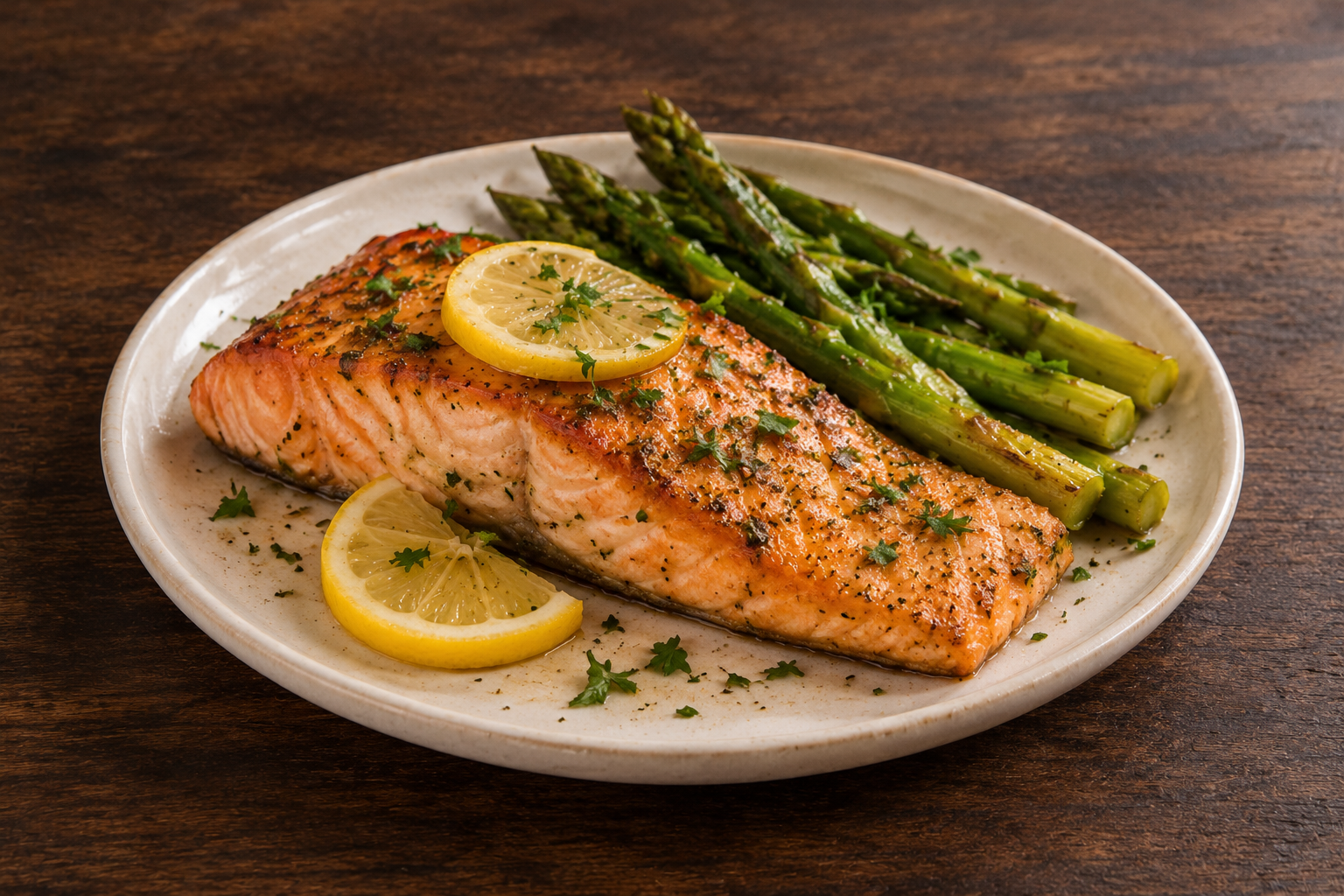
Salmon is one of the fastest high-protein dinners you can make in an air fryer. A seasoned fillet goes into the basket with a handful of asparagus, and about 8 minutes later you have a crisp, golden top, a juicy center and a full plate with roughly 37 g of protein.
Below you’ll find the recipe, a timing chart for thin and thick fillets, how to tell when salmon is done, four easy seasoning ideas, and what the color of salmon really tells you.
| Protein | Calories | Time | Serves | Protein Score |
|---|---|---|---|---|
| About 37 g per serving | About 455 kcal | 5 min prep + 8 min cooking | 2 | B (8.1 g per 100 kcal) |
Nutrition is for one 6-oz fillet with asparagus, estimated from USDA FoodData Central [1]. How we calculate our numbers.
Air fryer salmon with asparagus
This makes 2 servings in a standard basket air fryer. If your basket is small, cook the asparagus first and keep it warm while the salmon cooks.
Air Fryer Salmon with Asparagus
Ingredients
Method
- Preheat the air fryer to 400°F (200°C) for 3 minutes.
- Pat the salmon dry with paper towels. Mix the olive oil, garlic, paprika, lemon zest, salt and pepper, and rub it over the top and sides of the fillets.
- Toss the asparagus with the olive oil and a pinch of salt.
- Place the salmon skin side down in the basket and arrange the asparagus around it, in a single layer.
- Air fry for 7–9 minutes for 1-inch fillets, until the salmon reaches 145°F (63°C) in the thickest part and flakes easily with a fork. Check thinner fillets after 5 minutes.
- Let the salmon rest for 2 minutes, then top with parsley and serve with lemon slices and the asparagus.
Notes
How long to air fry salmon
Thickness matters much more than weight. Measure the thickest part of the fillet and use this as a starting point at 400°F (200°C):
| Fillet thickness | Air fryer time | Notes |
|---|---|---|
| ½ inch (about 1.5 cm) | 5–6 minutes | Tail pieces and thin fillets; check early |
| 1 inch (about 2.5 cm) | 7–9 minutes | Most supermarket fillets |
| 1½ inches (about 4 cm) | 10–12 minutes | Thick center-cut pieces |
| Frozen, 1 inch | 12–14 minutes | Rinse off the ice glaze, pat dry and season halfway through |
Air fryers vary a lot between brands, so the first time you make it, check a minute before the time in the chart.
How to tell when salmon is done
- With a thermometer: the U.S. food safety guidelines recommend cooking fish to 145°F (63°C) in the thickest part [2].
- Without a thermometer: the flesh should no longer look translucent and should flake apart easily with a fork [2].
- White drops on top are albumin, a protein pushed out as the fish cooks. A little is normal; a lot usually means the salmon is overcooked.
- Let it rest for 2 minutes before serving. The heat keeps spreading from the outside to the center.
Four easy seasonings
The recipe uses a classic lemon, garlic and paprika rub, but salmon works with almost anything. Each of these covers 2 fillets:
| Style | Mix | Serve with |
|---|---|---|
| Lemon garlic (recipe) | 1 tsp olive oil, 2 garlic cloves, ½ tsp paprika, lemon zest, salt, pepper | Asparagus or green beans |
| Honey soy | 1 tbsp low-sodium soy sauce, 1 tsp honey, 1 tsp grated ginger | Rice and broccoli |
| Cajun | 1 tsp Cajun seasoning, ½ tsp garlic powder, a pinch of brown sugar | Corn and a green salad |
| Mustard dill | 1 tbsp Dijon mustard, 1 tsp dried dill, a squeeze of lemon | Roasted potatoes |
Sweet glazes like honey soy brown fast. Brush them on for the last 2–3 minutes so they don’t burn.
Why salmon is worth eating every week
A 6-oz fillet of Atlantic salmon has about 35 g of protein and more than 3 g of the omega-3 fats EPA and DHA [1]. The Dietary Guidelines for Americans recommend at least 8 ounces of seafood a week on a 2,000-calorie diet, and the FDA and EPA list salmon among the “Best Choices” for its low mercury level [3].
Two salmon dinners a week cover that recommendation. If you’re pregnant or breastfeeding, the same advice suggests 2–3 servings a week from the “Best Choices” list [3].
What the color of salmon really tells you
Salmon gets its pink-orange color from astaxanthin, a pigment made by algae. Wild salmon get it by eating krill and shrimp that have eaten those algae. Farmed salmon can’t hunt, so astaxanthin is added to their feed. Without it, the flesh would be pale gray [4].
So color doesn’t tell you whether a fillet is wild or farmed, or how fresh it is. Species matters more: sockeye is naturally deep red, while some Chinook salmon are naturally white [4]. (That explainer comes from the Aquaculture Stewardship Council, a group that certifies fish farms, but the basic biology is well established.) To judge freshness, look for firm flesh, a mild sea smell and no dry or brown edges.
Why a 10-minute dinner matters
As a psychologist, I think the biggest obstacle to eating well isn’t knowledge but friction: after a long day, takeout wins because it’s easier. That’s why fast home recipes matter.
In a study of more than 9,000 U.S. adults, people who cooked dinner at home 6–7 times a week ate fewer calories, less fat and less sugar than those who cooked once a week or less, about 2,164 vs 2,301 calories a day. They also made lighter choices when they did eat out [5]. It’s an observational study, so it can’t prove that cooking causes the difference, but it shows how much small, repeatable habits add up. A salmon dinner that takes less time than a delivery order is an easy way to make cooking the default.
What to serve with it
- Vegetables in the same basket: asparagus, green beans or broccoli florets cook in about the same time.
- A carb for active days: brown rice, quinoa or roasted potatoes. My air fryer loaded fries also work as a weekend side.
- A cool sauce: Greek yogurt with lemon, dill and a pinch of salt adds about 5 g of protein per ¼ cup.
- For meal prep: pack cooked salmon with rice and vegetables for lunch, like the boxes in my meal prep lunch boxes.
Storage and leftovers
- Fridge: keep cooked salmon in an airtight container for 3–4 days [6].
- Reheat gently: 3–4 minutes in the air fryer at 300°F, or eat it cold flaked over a salad, which keeps it from drying out.
Frequently asked questions
Do I need to flip salmon in the air fryer?
No. Cook it skin side down the whole time. The hot air cooks the top, and the skin protects the bottom and helps the fillet hold together.
Should I use parchment paper?
You can use perforated air fryer liners for easier cleanup. Never put a loose sheet of parchment in the basket without food on top, because the fan can blow it into the heating element.
Is wild or farmed salmon better?
Both are good sources of protein and omega-3. Farmed Atlantic salmon is usually fattier and higher in calories; wild salmon is leaner. Choose what fits your budget.
Can I cook salmon without the skin?
Yes. Lightly oil the basket and reduce the time by about a minute, because skinless fillets cook a little faster.
Sources
- USDA Agricultural Research Service. FoodData Central. fdc.nal.usda.gov
- FoodSafety.gov (U.S. Department of Health and Human Services). Safe Minimum Internal Temperatures. foodsafety.gov
- U.S. Food and Drug Administration and U.S. Environmental Protection Agency. Advice About Eating Fish. fda.gov
- Aquaculture Stewardship Council. How does salmon get its colour? 2022. asc-aqua.org
- Wolfson JA, Bleich SN. Is cooking at home associated with better diet quality or weight-loss intention? Public Health Nutr. 2015;18(8):1397–1406. Johns Hopkins
- USDA Food Safety and Inspection Service. Leftovers and Food Safety. fsis.usda.gov
This article is for general information and is not medical advice. Nutrition values are estimates and vary with the type of salmon you buy.