
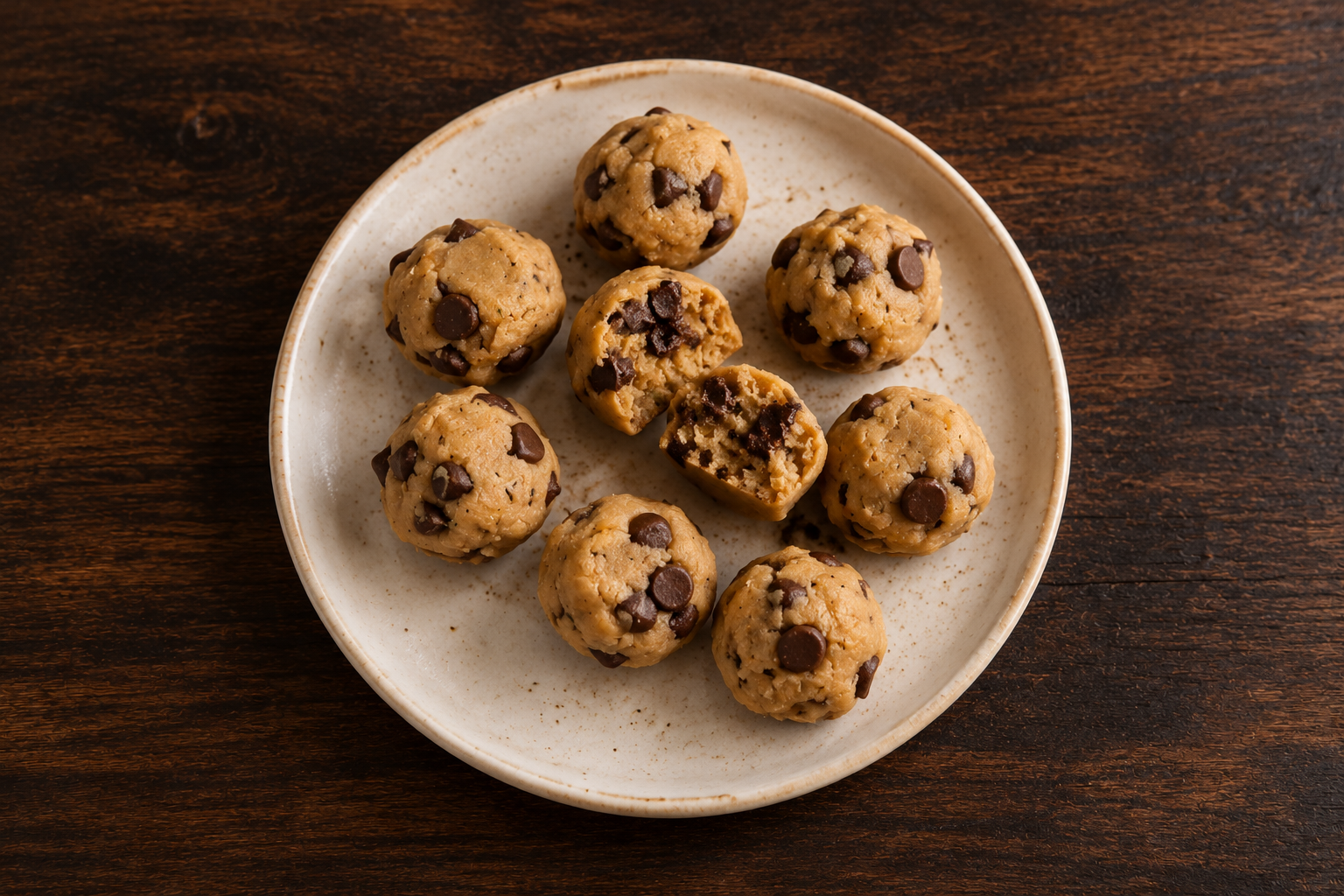
These cookie dough protein balls taste like the spoonful of dough everyone sneaks from the bowl, but they’re made to be eaten that way: no eggs, no raw wheat flour and no oven. Oats, peanut butter, vanilla protein, a little honey and mini chocolate chips, rolled into 12 bites with about 8 g of protein each.
They take 15 minutes, keep in the fridge for a week and are easy to grab between meals or before a workout. Below: what each ingredient does, how to fix dough that’s too sticky or too dry, and a little psychology that explains why small bites are the smartest snack size.
| Protein | Calories | Time | Makes | Protein Score |
|---|---|---|---|---|
| About 8 g per ball | About 150 kcal | 15 min + 20 min chilling | 12 balls | C (5.2 g per 100 kcal) |
Nutrition is estimated from USDA FoodData Central [1] and a typical whey protein label. How we calculate our numbers. An honest note: peanut butter and chocolate make these calorie-dense, so they score C. Two balls make a satisfying snack with about 15 g of protein.
What each ingredient does
| Ingredient | Its job | Swap |
|---|---|---|
| Rolled oats, blended into flour | Body and that “dough” texture | Quick oats work the same |
| Natural peanut butter | Fat, flavor and the glue that holds everything together | Almond or cashew butter for a lighter, more cookie-like color |
| Vanilla whey protein | Most of the protein and a cookie dough flavor | A whey-casein blend; plant protein needs a splash more milk |
| Honey or maple syrup | Sweetness and stickiness | Sugar-free syrup, with 1 tbsp more nut butter |
| Milk | Adjusts the texture | Any milk |
| Mini dark chocolate chips | Chocolate in every bite | Chopped dark chocolate or cacao nibs |
Cookie dough protein balls recipe
This makes 12 balls of about 1¼ inches. A small cookie scoop keeps them all the same size, which also keeps the nutrition accurate.
Cookie Dough Protein Balls
Ingredients
Method
- Blend the rolled oats in a blender or food processor for 30–60 seconds, until they turn into a fine flour.
- In a bowl, mix the peanut butter, honey, vanilla and salt until smooth.
- Add the oat flour and protein powder and stir until combined. Add milk 1 tablespoon at a time until the dough holds together when pressed, like soft cookie dough.
- Fold in the mini chocolate chips.
- Chill the dough for 15–20 minutes if it feels sticky, then roll into 12 balls of about 1¼ inches, using a small cookie scoop or about 1½ tbsp of dough each.
- Refrigerate in an airtight container for at least 20 minutes before eating.
Notes
Getting the texture right
Protein powders and nut butters vary a lot, so the dough is rarely perfect on the first mix. Use this quick fix chart:
| Problem | Why it happens | Fix |
|---|---|---|
| Too sticky to roll | Runny nut butter or too much honey | Add 1 tbsp oat flour or protein powder at a time, or chill the dough for 15 minutes |
| Crumbly and dry | Thick nut butter or a very absorbent protein | Add milk 1 tsp at a time |
| Chalky taste | Too much protein powder | Use no more than 2 scoops per cup of oats |
| Chips won’t stick | Dough too dry | Press the chips into the outside after rolling |
Tip: lightly wet your hands before rolling. The dough won’t stick to your palms and the balls come out smooth, like the ones in the photo.
Why small bites make a smarter snack
This is my favorite part as a psychologist. Researchers at the University of Pennsylvania noticed that people tend to treat “one unit” of food as the right amount, whatever its size. In their experiments, people offered snacks like pretzels or Tootsie Rolls in larger pieces took more, and people serving themselves M&M’s with a bigger spoon ate substantially more. The researchers called this unit bias [2].
You can use the same bias in your favor. When a snack comes in small, identical portions, one or two feels like a complete serving, and it’s easy to know exactly what you ate. That’s why this recipe makes 12 small balls instead of a tray of bars you cut by eye. Keep them in a container in the fridge and take two, rather than eating from the bowl.
When to eat them
- Before a workout: one or two balls 1–2 hours before training give you carbs from the oats and honey plus some protein, without feeling heavy.
- For the afternoon slump: pair one ball with a piece of fruit or a coffee. The protein and fat make it more filling than a cookie of the same size.
- As dessert: one ball after dinner satisfies a sweet craving with a fraction of the sugar of a slice of cake.
- On busy days: keep a few in your bag or lunch box for the moments when the only other option is a vending machine.
Is it safe to eat “raw” cookie dough?
Regular cookie dough isn’t, for two reasons: raw eggs and raw wheat flour. The FDA warns that flour is a raw food that can carry bacteria such as E. coli and Salmonella, that you should never eat raw flour, dough or batter, and that home methods of heat-treating flour aren’t reliable [3].
That’s why this recipe has no eggs and uses rolled oats instead of wheat flour. Rolled oats are steamed and lightly toasted during processing, before they’re rolled [4]. If you want to be extra careful, especially for children, pregnant women or older adults, look for oats labeled as heat-treated, or bake the balls for 10 minutes at 350°F for a soft cookie version.
A sweet piece of history
The chocolate chip cookie that inspired these bites was invented in the 1930s by Ruth Wakefield at the Toll House Inn in Whitman, Massachusetts. She chopped up a bar of semi-sweet chocolate for a batch of cookies, and the pieces held their shape instead of melting. Nestlé later printed her recipe on its chocolate packaging, and in return she reportedly got a lifetime supply of chocolate [5].
Flavor variations
| Version | What to change | Protein per ball |
|---|---|---|
| Birthday cake | Add 1 tbsp rainbow sprinkles and use almond butter | About 7 g |
| Double chocolate | Use chocolate protein and add 1 tbsp cocoa powder | About 8 g |
| Oatmeal raisin | Swap the chips for raisins and add ½ tsp cinnamon | About 8 g |
| Snickerdoodle | Skip the chips and roll the balls in cinnamon | About 8 g |
Want a bigger dessert? Try my dark chocolate peanut brownies or the cottage cheese cheesecake.
Storage
- Fridge: keep them in an airtight container for up to 1 week.
- Freezer: freeze them on a tray, then transfer to a bag for up to 3 months. They thaw in about 10 minutes, or can be eaten straight from the freezer.
- On the go: they hold well for a few hours in a lunch box, but get soft in a warm car or bag.
Frequently asked questions
Can I make them without protein powder?
Yes. Replace the protein powder with ⅓ cup more oat flour and 2 tbsp powdered peanut butter. Each ball will have about 4–5 g of protein.
Are protein balls good for weight loss?
They can fit into a weight-loss plan as a planned snack, but they aren’t low in calories. Pre-portioning them, as above, makes it much easier to eat one or two and stop.
Can I use regular flour?
Not raw. Uncooked wheat flour isn’t safe to eat according to the FDA, and home heat-treating isn’t reliable. Stick to oats, or bake the balls.
Why are my protein balls hard after freezing?
Nut butter firms up when cold. Let them sit at room temperature for 10 minutes before eating.
Sources
- USDA Agricultural Research Service. FoodData Central. fdc.nal.usda.gov
- Geier AB, Rozin P, Doros G. Unit bias: a new heuristic that helps explain the effect of portion size on food intake. Psychol Sci. 2006;17(6):521–525. PubMed
- U.S. Food and Drug Administration. Handling Flour Safely: What You Need to Know. fda.gov
- Rolled oats. Wikipedia. wikipedia.org
- Lemelson-MIT Program. Ruth Wakefield. lemelson.mit.edu
This article is for general information and is not medical advice. Nutrition values are estimates and vary with the nut butter and protein powder you use.